Fellowship: Yale University Law School, Law, Ethics, and Animals Program, Senior Litigation Fellow in Climate Change and Animal Agriculture (Deadline: ASAP/Ongoing)

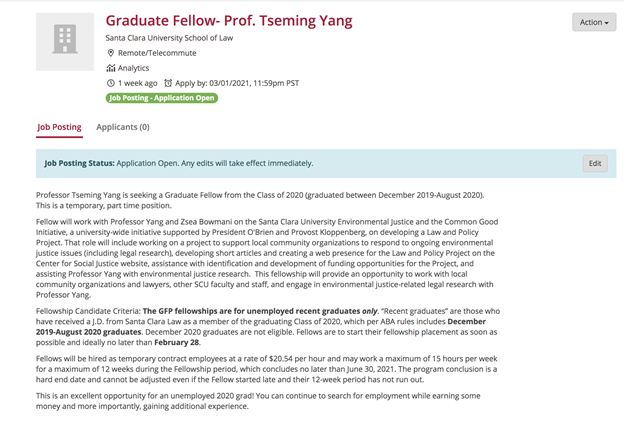
The Law, Ethics, and Animals Program at Yale Law School invites applicants for a Senior Litigation Fellow to help lead a new initiative within the Climate, Animal, Food, and Environment Law & Policy Lab that examines the likelihood and potential impact of climate change litigation against industrial animal agriculture firms. This is an unusual opportunity to lead a high-impact and cutting-edge research initiative. The Senior Litigation Fellow will receive a two-year appointment and will begin in the fall of 2021.

The full job listing, including information about how to apply, can be found here and is pasted below. Applications will be accepted until the position is filled. If you know folks who might be interested, we would be very grateful for your help spreading the word!

Climate Change and Animal Agriculture Senior Litigation Fellow and Project Manager

The Law, Ethics, and Animals Program (LEAP) at Yale Law School is hiring a Senior Litigation Fellow to help lead a new project within the Climate, Animal, Food, and Environment Law & Policy Lab (CAFE Lab) that examines the likelihood and potential impact of climate change litigation against industrial animal agriculture firms. The position will last two years and will begin as early as September 2021. This is a rare and unusual opportunity to lead a high-impact and cutting-edge research initiative at a preeminent university.

The primary responsibility of the Senior Fellow will be to lead and oversee research, publications, and events for the climate change and animal agriculture litigation project. With guidance and engagement from LEAP faculty and with support from student research assistants, the Senior Fellow will be responsible for producing a background report on the animal agriculture industry, its contributions to climate change, and its exposure to climate change litigation; organizing an expert workshop in summer 2022; and pursuing projects, research, and publications during academic year 2022-2023 that build upon the report and workshop.

The ideal candidate will have the following qualifications:

  • –  Graduation with a distinguished academic record from law school;
  • –  Substantial experience in animal law, environmental law, or other relevant areas of practice;
  • –  Record of scholarship, policy briefs, legal briefs, or other relevant publications;
  • –  Comfort interpreting scientific literature and technical concepts;
  • –  Strong interpersonal skills and enthusiasm for teamwork;
  • –  Capacity to work hard, efficiently, and independently; and
  • –  Commitment to public service or social justice work.

The Senior Fellow will receive a competitive salary stipend commensurate with experience level plus Yale University benefits. Although the position is funded for two years, we would be willing to accept a shorter tenure for exceptional candidates who require it to arrange a leave of absence from their permanent employer.

Application materials should be sent to douglas.kysar@yale.edu and include the following:

  • cover letter describing the candidate’s qualifications and including a statement of the applicant’s interests and experience;
  • resume;
  • law school transcript;
  • sample of recent scholarly, policy, or advocacy writing; and
  • contact information for two to three references.

We strongly encourage applications from candidates whose identities have been historically under-represented in the legal profession and the animal and environmental protection movements.

Applications will be accepted until the position is filled. Please direct any questions about the position or the application process to douglas.kysar@yale.edu.

Yale University considers applicants for employment without regard to, and does not discriminate on the basis of, an individual’s sex, race, color, religion, age, disability, status as a veteran, or national or ethnic origin; nor does Yale discriminate on the basis of sexual orientation or gender identity or expression. Title IX of the Education Amendments of 1972 protects people from sex discrimination in educational programs and activities at institutions that receive federal financial assistance. Questions regarding Title IX may be referred to the University’s Title IX Coordinator, at TitleIX@yale.edu, or to the U.S. Department of Education, Office for Civil Rights, 8th Floor, Five Post Office Square, Boston MA 02109-3921. Telephone: 617.289.0111, Fax: 617.289.0150, TDD: 800.877.8339, or Email: ocr.boston@ed.gov.

Tenure-Track Energy/Oil & Gas Law Faculty Position: University of North Dakota Law School (Deadline: Ongoing)

The University of North Dakota School of Law is currently hiring for several tenure-track faculty positions, including a position focusing on energy law as well as oil and gas law.  The link to UND’s hiring page, which includes the UND School of Law’s faculty posting:

Fellowship: University of Houston Law Center EENR Center, Post-graduate Research Scholar re Carbon Capture (Deadline: ASAP/September)

A fellowship notice from my emails:

UHLC’s EENR Center will be hiring a post graduate research scholar to coordinate legal research in carbon capture and management.  There are now multiple proposals for at scale carbon sequestration programs, particularly for the industrial corridor along the Gulf Coast.  The Center for Carbon Management at UH is supplying funding to EENR for up to 4 years for a person to coordinate research on legal and policy impacts surrounding carbon management.  The position will be supervised by EENR’s co-drectors: Gina Warren, Tracy Hester, and Victor Flatt/

All applicants must apply through the University’s hiring portal, which has more specific information:

Job Description – Research Scholar – Environment, Energy & Natural Resources (FAC001858) (taleo.net)

We will begin reviewing applications immediately and would like to hire by September.

United States Must Prepare for Impending Climate Refugee Crisis

Climate change has and will continue to force people all over the world to leave their homes.  Climate stressors such as rising sea levels, flooding and changing rainfall patterns are increasingly making different areas of the world inhabitable. The World Bank predicts that Sub-Saharan Africa, South Asia and Latin America could have more than 140 million people displaced by 2050.  Many of the people currently being displaced are migrating within their own countries; however, as more people are forced to leave their homes, there will be far more international movement.  

The United States is not immune from the effects of climate refugees.  After Hurricane Maria hit Puerto Rico, tens of thousands of Puerto Ricans were forced to flee the island, most of which came to the U.S. mainland. The United States cannot pretend this problem is not imminent. However, the United States has done little to prepare for the influx of asylum-seekers.

Under current United States law, the definition of a refugee is extremely limited.  In order to be a refugee, one must be “unable or unwilling to return to […] that country because of persecution or a well-founded fear of persecution on account of race religion, nationality, membership in a particular social group, or political opinion.” This definition of refugee completely ignores the growing levels of displacement due to environmental factors.  The term “persecution” only applies to those who are forced to leave their country due to violence by other people; and does not include the possibility of their homes becoming inhabitable because of the climate conditions.

The U.S. must be a leader in preparing the world for handling the large numbers of people who will be forced to find a new home.  The first step in that process is changing how we define the term “refugee” in U.S. law to include those who cannot return to their countries of origin due to the impacts of climate change. If we do not make this change, we will have an increase in illegal immigration and, more importantly, we will be contributing to the devastation that faces people who are already forced to leave everything behind.

Nikki Dow


Groundwater Rise: An International Problem that California Must Solve

The devastating effects of climate change are numerous, diverse, and often disrupt our best-laid plans.  One novel issue which is only now starting to get attention is groundwater rise.  When we think of sea-level rise, we often think about the ocean encroaching our coastal shores and flooding our beaches – but we forget about the waterways in the ground beneath our feet. Groundwater fills the holes and fractures in underground materials like water fills a sponge. It can be deep in the earth, or shallow and near the surface.  Along coasts, underground saltwater floats directly beneath the freshwater.  When underground saltwater rises with the rising seas, it is expected to push the groundwater up and sometimes even out of the ground.  In addition to flooding basements and impacting plumbing, this rise can also crumble roads and create extended earthquake liquefaction zones. In 2012, Hawaiian scientists discovered the earliest first-hand evidence of the phenomena already in action.

Global climate change is expected to cause at least an average one foot rise in sea levels by the end of the century, with a three foot rise in California, but it may end up being much more. A survey in one Bay Area city found local groundwater to currently be an average of six feet below the surface near the Bay edge, and often as close to the surface as only one to two feet below. Even a small rise in sea levels can have devastating effects with already shallow groundwater. The effects become even more problematic if the groundwater is contaminated by chemicals.  For those who live or work near the shore and in polluted areas, sleeping monsters are about to awake.

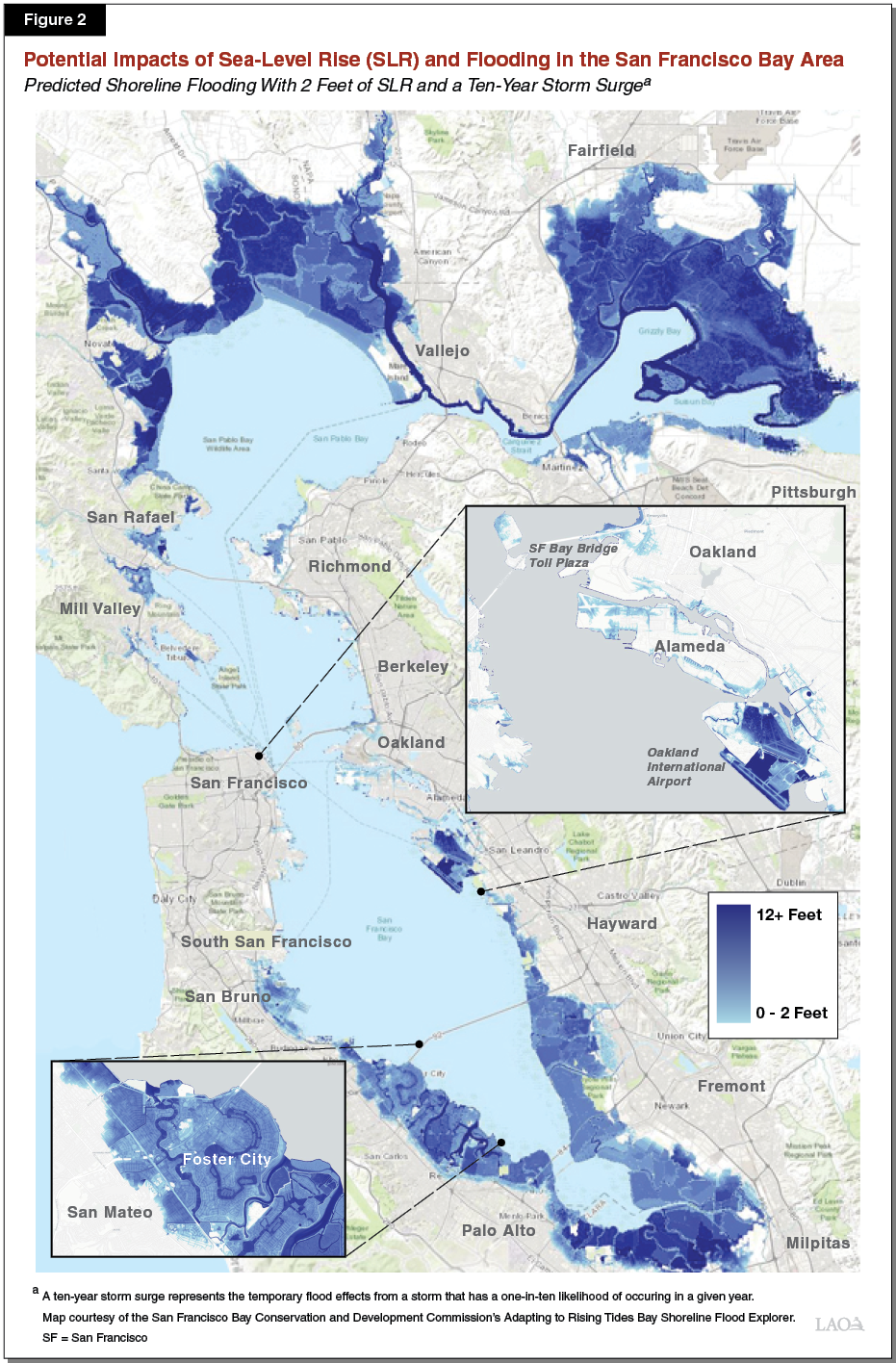
Potential Impacts of Sea-Level Rise (SLR) and Flooding in the San Francisco Bay Area: https://lao.ca.gov/reports/2019/4121/Fig2.png
California LAO: Preparing for Rising Seas: How the State Can Help Support Local Coastal Adaptation Efforts

When chemicals pollute soil and groundwater, the contamination may be mitigated by procedures to contain the toxins and reduce the risk to humans nearby. However, these containment procedures generally factor in the current depth of the groundwater at that time and there is usually no follow up later to assess if the mitigation is still sufficient (such as if physical circumstances changed in the area).  More than 945 EPA Superfund sites are at risk due to global climate change generally, and 330 EPA Superfund sites were found to be at risk of flooding due to only five feet of sea level rise. The California LAO recently stated, “floodwaters could penetrate both surface-level and underground tanks and force out toxic liquids, or liberate waste from pits or piles.” Though, this analysis does not even consider vapor intrusion risks as the groundwater rises closer the surface.

The issue of contaminated groundwater rise has been overlooked by city planners and decision-makers for decades, but we cannot wait any longer.  Many coastal cities across the world will be impacted by this issue.  California has an impressive history of environmental innovation and pioneering novel solutions to address global climate change. This issue should be no different — not only because the world needs a solution, but because this issue will be disastrous for Californians if we cannot get ahead of it at home.

– Ashley Gjovik

Ashley is an advocate for human rights, including healthy environments. She is currently a law student at Santa Clara University studying international public interest law and policy. 

Remarkable Climate Change Decision from a French Court

While there is a wealth of climate cases pending in courts across the world, success for climate activists has been very limited. Last year, in the Urgenda case, the Dutch Supreme Court affirmed an earlier lower court decision finding that the government had not done enough to cut greenhouse gas emissions. This French decision is apparently the first in France finding the government liable for climate harms.