
I have just put my article manuscript, “The Emergence of the Environmental Impact Assessment Duty as a Global Legal Norm and General Principle of Law,” on the Social Science Research Network. [Here is a link to the article abstract on SSRN, with link to the manuscript: https://papers.ssrn.com/sol3/papers.cfm?abstract_id=3202454.] It’s both an empirical study of the worldwide adoption of the environmental impact assessment norm (i.e. the requirement to engage in EIA analysis for projects and activities that have the potential to cause significant impacts on the environment) as well as an examination of the normative implications of this development for environmental law internationally and in national legal systems. (In the US, this norm has existed in our environmental law system since the enactment of the National Environmental Policy Act in 1969.)
The most interesting (in my view) and possibly the most controversial claim of my article is that the EIA norm has become a general principle of law in public international law. If this argument is accepted in public international law, this would have significant implication for international environmental law in that the EIA norm would be deemed LEGALLY BINDING as a matter of public international law. (For more details on this argument, see the article.)
Here is also the abstract of the paper itself:
More than half a century ago, Rudolph Schlesinger announced a global survey of legal principles in the pages of the American Journal of International Law. The project’s objective was the identification of a “common core” of legal norms among the family of nations and the ultimate goal the production of something akin to a global restatement of law. Such an endeavor was to yield global principles of law, ultimately giving substance to the General Principles of Law provision under Article 38 of the Statute of the International Court of Justice. In spite of the initial enthusiasm surrounding the project, its ultimate goal was never realized.
Five decades later, the prospect of engaging in such a project, focused on the environmental law field, promises more fruitful outcomes. In this article I argue that globalization and other trends have made the EIA duty – the duty to perform environmental impact assessments for projects that are likely to have a significant impact on the environment — a globally accepted norm. A 197-jurisdiction survey finds that the duty has been nearly universally adopted. The article suggests that the EIA duty may now be seen as a “general principle of law recognized by civilized nations,” and in that sense has joined the body of public international law. Finally, the survey results also point to comparative law methodology as a promising opportunity for identifying new legal norms in the international environmental law field, independent of the cumbersome process of treaty negotiation or the time-consuming development of customary law.
Unfortunately, I am not quite done cleaning up the database of the empirical study – however, it is intended to be publicly available so that it can be reviewed together with the paper. I expect this to be completed soon. [The database is quite massive, and I am only making parts of its available; it took a couple of years and the work of 2 research fellows to assemble.]
I am including 2 slides (below) from a recent talk that I gave at VLS on this. Here is the summary chart of the database.

The second slide is a graphical representation of the chart, created by my research fellow Phoebe Wu.

[The map is based on a UN map; all the blue states/jurisdictions are places that have an EIA legal mandate as part of their legal systems; red states/jurisdictions do not have an EIA requirement; green are the states/jurisdictions for which we were not able to make a definitive determination (within our confidence criteria) as to whether an EIA duty existed in that jurisdiction.]
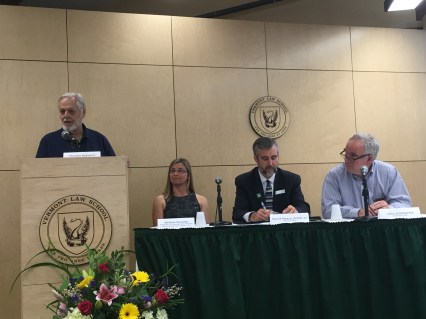 Today, Vermont Law School celebrated the 40th anniversary of the law school’s Environmental Law Center. Past directors (David Mears, Melissa Scanlan, John Echeverria, Marc Mihali, Karin Sheldon, Pat Parenteau, and Dick Brooks) were on hand to provide a nostalgic review of the Center’s history and accomplishments. The event was followed with a presentation of a set of Festschrift contribution for the Center’s founding Director, Richard Brooks, and his scholarly work. It was a touching tribute to the person who started it all.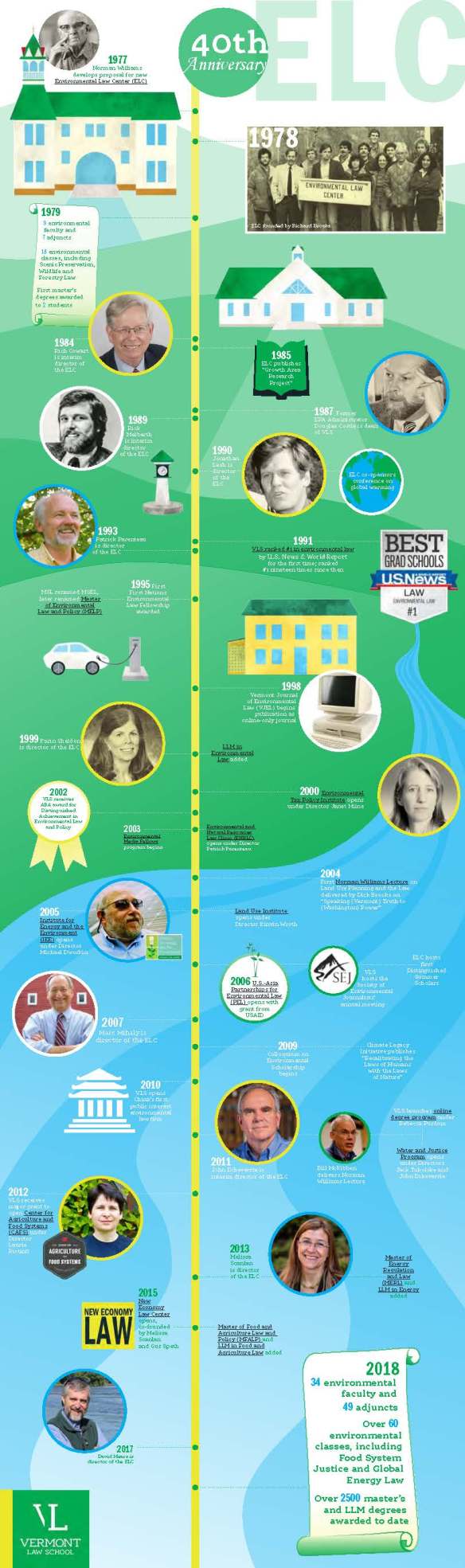


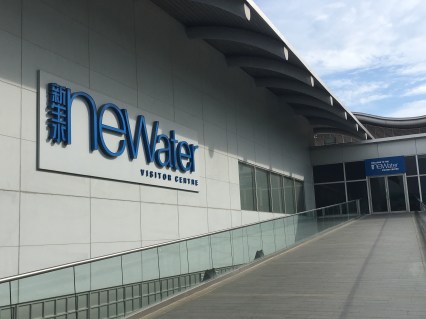 We were treated to an interesting lecture about


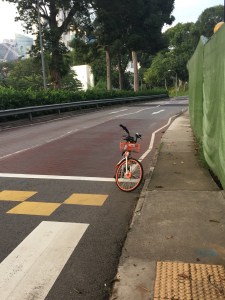
 I have been taking advantage of one of the the many bike share companies here in Singapore. The picture is of an Anywheel bike. It’s been incredibly convenient – bikes are unlocked with a smartphone app, and the app keeps track of the bike’s whereabouts via GPS. And even though public transportation is quite well designed, having a simple means of transportation for shorter distances has been very convenient, especially in this tropical heat and humidity. The government also encourages use of bikes (and electric scooter) by allowing people to ride on the sidewalks and setting aside special bike lanes on the sidewalks in some parts of the city. One of the great benefits for a tourist like me has been the ability to avoid the street and cars. Singapore follows the British in driving on the left side of the road, which has led to me having near-accidents in the past when I have been in this part of the world.

 Our “Business and the Environment” course had the opportunity to visit Singapore’s Supreme Court on Wednesday. Fascinating to hear the story of this legal system and how this country’s judiciary has been taking active steps to market its system across Asia, especially as a preferred forum and choice of law system to resolve commercial disputes. We also had a chance to observe part of a criminal appeal that was taking place in the High Court. One of the most interesting aspects of our visit was the back-story to the architecture of the building Supreme Court building. The top floor is designed to resemble a space ship (a flying saucer) and symbolizes the institution’s forward-leaning future-oriented perspective.
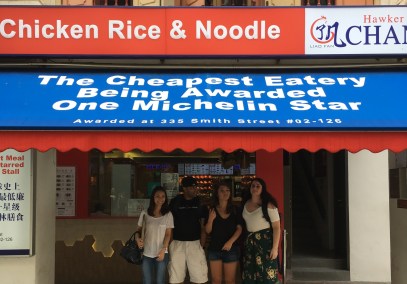 It’s been hot but exciting to be in the heart of Southeast Asia. After a day’s worth of lectures on business organizations for the “Business and the Environment,” the students have been been exploring Singapore. On Tuesday, our post-class excursion was to check out the world’s cheapest Michelin-starred restaurant – the Liao Fan Hong Kong Soya Sauce Chicken Rice, a Hainan chicken rice Hawker stand at 335 Smith Street. We ended up at the newer, air-conditioned restaurant, where the price was less than $3 USD for the signature chicken rice meal. My personal review . . . Not bad, but I am not sure that the meal was Michelin-star-worthy. But either way, it was an interesting experience.


 Citizen Yang