"Let them Drink Milk"

In a recent spate of lead poisonings that has occurred in Shuiyang township in Gansu province, suspected to be the result of a state-owned smelter in a nearby village, public health experts have told the victims to drink more milk and eat more nutrients to lower the blood lead levels. (SCMP 9/9/06). Of course, the victims are too poor to afford milk. More than 800 people, including 334 children have been found to have abnormal lead levels. 368 of them are deemed to have lead poisoning. The smelter was shut down last month. The central government has been investigating, but has not come up with any remedy for the residents.

There was also an interesting op-ed piece in the New York Times about China’s future. (Ross Terrill, China is not just Rising, but also Changing, 9/9/06). No mention of its environmental problems though.

Professor Xu Kezhu of the Center for Legal Assistance to Pollution Victims visits VLS


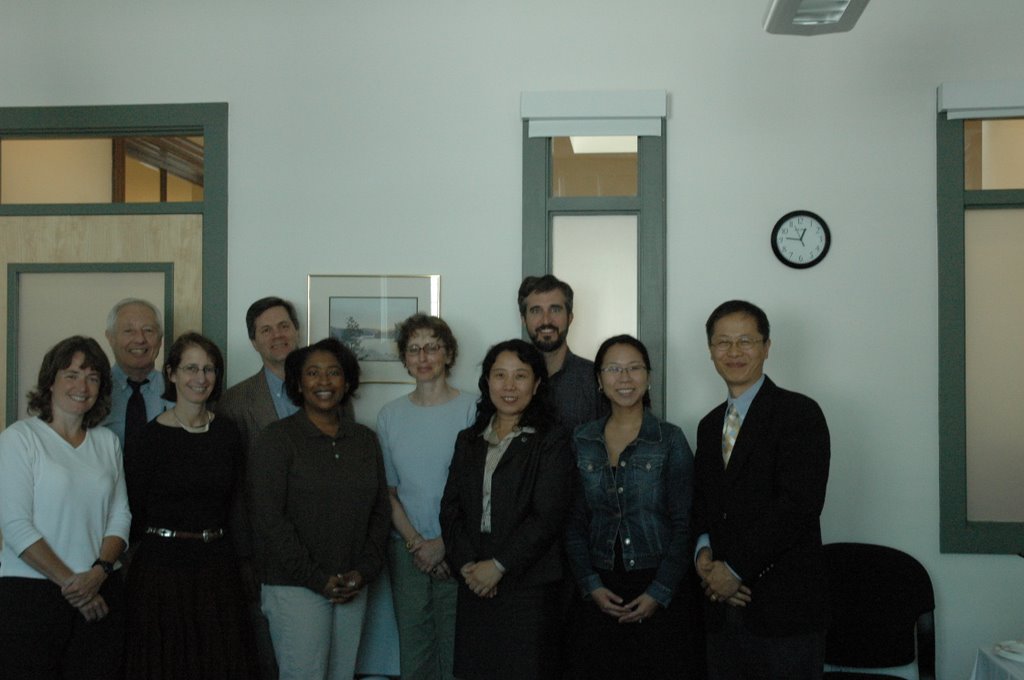
Prof. Xu Kezhu, the deputy director of the Center for Legal Assistance to Pollution Victims visited Vermont Law School last week. It was delightful to welcome her to our neck of the woods. She gave a presentation about CLAPV and her work at the China University of Political Science and Law. She also met with VLS’ environmental law clinic.

She is in the US on a 3-week whirlwind tour to meet with government agencies, NGOs, and universities. She was in DC and New York and now is in San Francisco. She made a special detour to Vermont Law School to see us.

What Happens After . . . Compliance with Environmental Orders

Jim Yardley of the NY Times has a very interesting article on China’s environmental regulatory problems in the 9/4 edition, involving a 2004 spill into the Yellow River in Inner Mongolia and environmental orders that were wilfully ignored by local officials. (Rules Ignored, Toxic Sludge Sinks Chinese Village, NY Times 9/4/06). A lawsuit related to a pollution spill resulted in a $300,000 compensation award for the city of Baotou and an order to install water treatment equipment. However, local officials ignored the order and, instead, built large temporary wastewater containment pools next to the river. A storm this past April threatened to release the polluted water into the Yellow River. In order to avoid discovery of their failure to comply with official clean up order and to close the responsible factories, local officials broke the containment walls and released the polluted water into an area where several small villages are located. Those villages are now uninhabitable.

Maybe just as interesting, however, are the circumstances of how Yardley got his story (as he explains in the article). Initially, he got strung along by provincial officials for an interview about the matter. Then, this past July, he went to one of the villages (together with a driver and photographer) to investigate directly, even thought the village had been declared off-limits. At the village, they were pursued by a car without license plates, but they were able to escape. Subsequently, they were stopped by the police, and the driver was interrogated for three hours.

The incident actually reminds me of an encounter with rural Chinese police several years ago. We were in a small minibus that had taken us from a Beijing youth hostel to a section of the Great Wall in Hebei province. We were stopped by local police, as we later realized, probably because the minibus had Beijing license plates. We had to disembark and were asked about why we were there. They also asked us to sign a statement (in Chinese), which we refused. After about an hour, they let us go; in fact, they brought us to the section of the Great Wall that we were supposed to get to. The minibus driver had to go the police station, but he rejoined us several hours later. We suspect that he was probably being shaken down because he was bringing tourists from Beijing (to the neighboring Hebei province).

The entire episode was quite unnerving because of all the things I had previously heard about rural police corruption. On the other hand, we pretended not to speak Chinese (and they realized that we were American Chinese), which helped us to get out of having to sign anything. Our minibus driver seemed to take it all in stride – all in a day’s work.
SEPA Investigations Announced & Contaminated Fish

SEPA is investigating the company (Changbaishan Jingxi Chemical Co.) that caused the pollutant spill into the Songhua river tributary last week (see my earlier posting). (Xinhua 9/3). Interestingly enough, there are also simultaneous SEPA investigations looking not only at other private companies but also local governments. These include the “county government of Xin’an in central China’s Henan Province has allowed the construction of more than 100 factories with no waste-treatment facilities since 1998. The municipal government in Jinhua in east China’s Zhejiang Province, allegedly interfered with the enforcement of environmental laws. The Yili Prefecture in northwestern China’s Xinjiang Uygur Autonomous Region is held responsible for the discharging of massive quantities of industrial pollutants.”

SCMP also noted in an article that fish and shrimp coming into Hong Kong from Guangdong province has been found to contain high levels of methyltestosterone and chloramphenicol, a male hormone and an antibiotic. (SCMP 9/3). Authorities suspect that the contamination is the result of fish farmers using these chemicals in the ponds used to raise the fish and shrimp.

A Little More Fall-Out from Songhua River Spill?

China Daily ran an article last week that the State-owned Asset Supervision and Administration Commission (SASAC) has been evaluating state-owned enterprises. (China Daily 8/23). Four received grades of D and two received a failing grade of E. The consequences of a poor performance evaluation could be not only cut in bonus and salary but also possible dismissal. China National Petroleum Corp. was among 4 companies that was downgraded because of safety or environmental violations, but it was not clear from the article what the actual grade of CNPC was.

NPC Finds Little Progress on Pollution

Based on a 15 province inspection conducted in May, the NPC’s Environment and Resources Protection Committee found that the pollution control efforts continue to lag. (SCMP 8/27) NPC Vice-Chairman Sheng Huaren pointed to fraud by local officials in reporting pollution figures and a failure to make pollution reduction a priority. ” “Many firms report a lower figure for chromium waste for fear of being punished,” said Sheng Huaren, vice chairman of the Standing Committee of the National People’s Congress (NPC), on Saturday when briefing lawmakers on the report.” For example, “A locality earlier reported that they had only 3,000 tons of chromium waste but raised the figure to 100,000 tons after they learned that the government would build reprocessing facilities for them instead of fining them, said Sheng.” (Xinhua 8/26) Other issues are underfunded pollution control efforts.

Spill Cuts Of Water Supply to City in Shaanxi Province

A tanker truck spilled 25 tons of caustic soda (sodium hydroxide) into a municipal reservoir for the city of Hancheng in Shaanxi province on Friday. (NY Times/AP 8/27). As a result the water supply for about 100,000 people in the city (total population about 400,000) was cut off for 2 days. After neutralizing with some 10 tons of hydrochloric acid, the water supply was restored on Sunday.

Songhua Tributary Spill not as Bad as Feared

Now officials say that the slick is not as serious as was feared, probably because of the early intervention. (China Daily 8/25) . It turns out that the Changbaishan Jingxi Chemical Co. in Jilin dumped 10 tons of industrial waste into the Mangniu river. According to China Daily, the facility “has been ordered to stop production and culprits have been punished” . . . whatever that means. Maybe letters of self-criticism?

It’s ironic (but not surprising, I suppose) that not even a year after the big benzene spill in Jilin, another company wilfully releases such a significant amount of toxic waste into the river. What happened to the “Environmental Storm” that SEPA has been pursuing? Seems to have been more of a gentle breeze . . .

Chemical Spill into Tributary of Songhua River

Xinhua News Agency ran a story reporting on a chemical spill into the Mangniu river, a tributary to the Songhua river. (Xinhua 8/23) The spill apparently occurred on Monday (8/21), and officials believe that it was due to an illegal discharge by the Changbaishan Jingxi Chemical Co. The tributary passes through the city of Jilin, which was the site of last November’s big benzene spill. The major pollution component of the 5 kilometer long pollution slick seems to be Xylidine.

Unlike the benzene spill into the Songhua last year, official response to this spill appeared to be much better. Three dams were built, including 2 containing active charcoal to filter the chemicals. So far, none of the pollutants have been detected in the Songhua river.