August 2016 California Carbon Auction Results

pollution

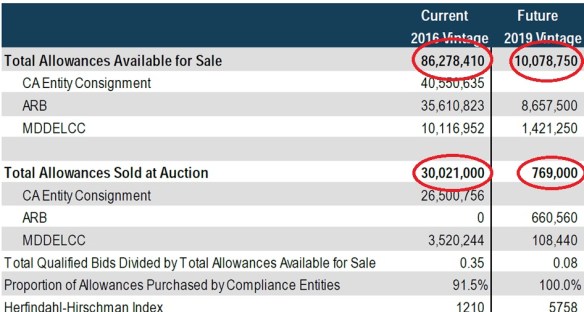
As I was preparing to teach my environmental law class yesterday, the California Air Resources Board released the quarterly carbon auction results from August 16, 2016.  Similar to the May 2016 auction result, there is reason to be concerned about the demand for carbon credits, though the outcome appears to be better than May.  For illustration, I cut out the chart from the CARB press release:

aug result

Less than 35% of the available 2016 vintage credits found buyers, and less than 10% of the future 2019 vintage credits (to be used in the future).  This is better than last May, when less than 10% of all available for sale found buyers.  Compare the August auction results to auction results for the past couple of years in the chart below from a CARB summary report:

lastcoupleyears

The results show how weak demand is, even though things appear to have improved from May. Weak demand for the future vintages, i.e. credits that cannot be used until a future compliance year suggests uncertainty among buyers/participants in the carbon market about the market’s future.  Under the current legislation, AB 32 (The Global Warming Solutions Act of 2006), there is only authority through 2020, by which California is supposed to reach its 1990 levels of carbon emissions.  However, yesterday, the California Assembly passed S.B. 32, which would extend the carbon emission reduction mandate to 2030 and lower the target to 40% below 1990 levels.

A couple of observations about these developments.  First, these auction results, especially the ones before May 2016 show how much the carbon market is worth and the dollars that are changing hands in a key area related to managing climate change and the environment.  Of course, the global carbon market, especially with the many different financing instruments that are involved, is even bigger in dollar size.  As somebody who teaches law students and is an observer of the environmental specialty in the legal industry (as part of my interest in helping students make careers as lawyers), however, it is surprising to me that we haven’t seen a greater resurgence of this specialty, yet.

Second, while California has been the undisputed forward-leaning leader in addressing climate change and developing a carbon market in the United States, these efforts will increasingly be affected by developments in the federal government and in the climate change treaties.  While the US EPA has been pro-active on climate change under this Administration, a signature initiative, the Clean Power Plan, is currently on hold because of pending litigation.  Similarly, international work under the climate change treaties has been going on for decades now.  However, conclusion of the recent Paris Climate Agreement marked a significant positive shift in US cooperation in these agreements and will likely create new opportunities for California.

Oakland City Council Votes to Ban Storage and Handling of Coal Throughout City of Oakland

OLYMPUS DIGITAL CAMERALast night, the Oakland City Council passed a resolution (San Francisco Chronicle’s website, East Bay Times) banning the storage and handling of  coal within city limits.  Most importantly, the City Council  is applying the new ordinance to the pending construction of a bulk goods terminal at the Port of Oakland.  The resolution/ordinance does not appear to be available on the Council’s website, yet, but the agenda with the title of the resolution is available here.

The construction of the coal terminal has been quite controversial for a number of reasons.  It would facilitate the export of coal mined in Utah to overseas markets in the Pacific region. Environmentalists see this as encouraging the continued use of coal, with attendant negative consequences for global climate change through the carbon emissions from burning them. The issues are very similar to those associated with the Keystone XL pipeline in recent years. That pipeline was passionately opposed by environmentalists because it would have facilitated the development and use of Canadian tar sands, significantly expanding market access to a very dirty fossil fuel and making it that much more difficult to dial back global GHG emissions.

Another concern has come from the environmental justice implications of this project.  Local environmental justice activists have noted the likely negative health consequences that could result from the potential steady stream of coal trains going through low-income and minority communities.  Fugitive coal dust coming from the coal trains could have serious effects on local air quality.  While the project proponents have denied such impacts, a recent Environmental Science Associates report commissioned by the City Council seemed to confirm these fears.  The mayor and city council have previously stated that they did not know (or were misled) about the anticipated use of the terminal for coal exports when they first entered into the agreement in 2013.

Interestingly, the West Oakland Environmental Indicators Projects, which has also worked against the coal terminal development, sent a letter to the Department of Interior and the Utah Attorney General suggesting that the project may be in violation of Title VI of the Civil Rights Act of 1964.  Under Title VI, recipients of federal funding are prohibited from engaging in discrimination on race, color and national origin. In addition, the regulations of many federal agencies also prohibit actions by fund recipients that merely have a discriminatory effect (rather than being purposefully discriminatory).  The letter suggests that there is a sufficient federal funding nexus to trigger Title VI prohibitions, but it is difficult for me to tell without more information.

Even though the Oakland City Council’s action last night was cheered by activists, the developer threatened that they would not give up.  There will likely be breach of contract claims.  Moreover, the Council’s attempt to block shipments that would transit Oakland on their way abroad raises the question whether this might run into trouble with the Constitution’s commerce clause, a provision that limits the ability of state and local authority to regulate interstate and foreign commerce.  (There is also the question whether there are applicable Department of Transportation regulations regarding such shipments.)

One thing is clear though — this is not the last we have heard of this issue.


Some Consequences of Brexit for Climate Change and Other International Environmental Cooperation?

Britain’s vote to leave the European Union will undoubtedly have huge political and economic consequences for the world, apart from creating lots of uncertainty.  That is also true for the reverberations that are to come for climate change and other international environmental cooperation efforts. Some reporting/commentary that I have seen herehere, and here has already focused on these issues  There are at least three issues to keep an eye on.

First, on climate change, some key issues arise out of how European countries have chosen to participate in international environmental treaties as a group over the past couple of decades.  As European cooperation had become tighter, and especially as more economic and environmental regulatory powers shifted to Brussels, EU member states began to participate in international environmental treaties not only in their own capacities, but also as part of the European Union.  Thus, many international environmental agreements since the 1990s have the EU participate as an entity separate and independent from its constituent countries.

23595388112_ebbad5a168_kThat applies to the various climate change treaties, including the recent 2015 Paris Climate Accord.  Since the GHG emission reduction commitments were provided as a group, Britain’s exit from the EU will require adjustment of both Britain’s and the EU’s emission reduction commitments in the Paris Agreement.  However, the legal implications of fixing the Brexit consequences for the Paris Agreement are likely to be messier than the practical ones for a simple  reason:  the Paris emission reduction goals were always intended to be non-binding. Hence,  failure to achieve them was never anticipated to carry any direct and formal negative consequences.

The second issue arises out of Britain’s participation in the EU’s environmental regulatory scheme, including the many environmental and climate change directives, and in the European Emission Trading System (ETS).  Britain’s exit from the EU system will make those regulatory directives inapplicable.  But it seems less certain to me how its participation in the ETS will be affected.  Assuming that Britain’s commitment to environmental cooperation with the rest of Europe continues, it is conceivable that something will be worked out to allow Britain’s continued participation.

Finally, with respect to Britain’s and the EU’s commitments in other multilateral environmental agreements concluded over the past 2-3 decades, issues similar to those arising out of the Paris Climate Accord are likely to come up.  A few such treaties readily come to mind:  the Stockholm Convention on Persistent Organic Pollutants, the Rotterdam Convention on Prior Informed Consent, the Convention on Biological Diversity, nd the Minamata Mercury Convention.  Again, there will need to be some adjustments (especially internally to those treaty bodies), but probably nothing earth-shattering, at least not from an international legal perspective.

The farther-reaching consequences may well come from the underlying political trends that led to Brexit in the first place.  What do they suggest for the future of environmental cooperation, and will they undermine the wave of good will and engagement that formed the basis for the Paris Accord?  There is also one other possibility that Brexit raises.  From a perspective of pure environmental opportunism, might Britain become more available and interested in closer environmental cooperation, especially on climate issues, with the United States?

I have to confess that I share a very small professional stake that has been affected by the Brexit.  For my comparative environmental law book, I had expected to rely on a number of British cases to illustrate how the European Union’s environmental regulatory structure works.  What now . . .  Is the sky falling?  (Or more accurately, how much will I need to change things when Britain’s exit from the EU is formally and legally completed in a few years.)  Even though this question is somewhat facetious, it really does raise interesting (and troubling) prospects for the future of international environmental cooperation (and international environmental law).

TSCA Reform Act (Frank R. Lautenberg Chemical Safety for the 21st Century Act) Signed by President

Just earlier today, President Obama signed H.R.2576, the Frank R. Lautenberg Chemical Safety for the 21st Century Act, into law (also commonly referred to as the TSCA [Toxic Substances Control Act] Reform legislation).  A link to the legislation that was sent to the White House for the President’s signature:  https://www.congress.gov/114/bills/hr2576/BILLS-114hr2576enr.pdf

Obviously, the new act does not come without concerns, as legislative analyses by the Safer Chemicals, Healthy Families coalition and by EDF indicate.  (Links below.)

Regardless, it is difficult to understate the historic nature of this legislation.  First, the Lautenberg Act updates the 1976 TSCA, which has not undergone a fundamental revision since its original enactment some 4 decades ago.  Many countries, especially the European Union system with its REACH system, have long ago put far more modern regulatory systems into place.  Second, it should make it far easier for EPA to do its regulatory job addressing the safety of chemicals since the legislation changes the legal standard that has essentially stalled much regulatory actions.  Since 1991, a federal appellate court decision in the Corrosion Proof Fittings case interpreted a provision to essentially halt EPA’s efforts to regulate asbestos.  Third, and most importantly from a big-picture environmental politics perspective, this is the first major piece of environmental reform legislation that the Congress has enacted since the 1990 Clean Air Act Amendments, more than a quarter century ago.  Consider that as an indication of how dysfunctional the federal legislative process has been over the past decades with respect to the environmental issues!

Historic deal on TSCA reform reached, setting stage for a new law after 40 years of waiting

http://saferchemicals.org/2016/05/21/e-near-final-tsca-reform-legislation-a-rundown


Update to “Mysteries, Myths, and Misunderstandings” article in March/April 2016 Issue of Environmental Forum

Zhang Jingjing, a leading Chinese environmental lawyer, and I have penned a short update (styled as a  joint letter to the editor) on a set of pieces, including my article, Mysteries, Myths, and Misunderstandings, which appeared in the March/April 2016 issue of the Environmental Forum.  The article introduced environmental lawyers and professionals to key issues they should be aware of when engaging in work in China.  The update appears in the forthcoming July/August 2016 issue and is available below.  Our update focuses on the April 28 enactment of the 2016 Foreign NGO Law, formally known as “The People’s Republic of China’s Law on the Management of the Activities of Overseas NGOs within Mainland China.”

Op-ed on "Sue and Settle" Law Suits by Environmental Organizations

My op-ed piece on “sue and settle” law suits by environmental organization just started running in a number of newspapers.  Here’s a link to the piece in the Deseret News:

http://www.deseretnews.com/article/865592856/Tactic-ensures-EPA-ignores-politics-fulfills-its-mission.html?pg=all

*********

Tactic ensures EPA ignores politics; fulfills its mission

SANTA CLARA, Calif. — “Sue and settle” is the ominous phrase that has been attached to cases where an environmental organization sues a federal agency, such as the Environmental Protection Agency, and then settles the matter without going through a full-blown trial.

These tactics, while not ideal, are important to our environmental system because they hold agencies like EPA accountable for the important regulatory work they are required to do by law, but sometimes do not undertake because of politics or other reasons that the laws do not accept as a basis for delay.

It’s true that litigation is rarely optimal for good policy-making. When agencies avoid resolution of important environmental policy issues through unreasonable delay or other illegitimate means, however, they also avoid public accountability for their responsibilities.

Judicial intervention then becomes necessary to prompt them to do what they should be doing anyway. Only after agencies have followed the regulatory process required by law, rather than avoiding it, can the public, green groups, polluters and others scrutinize and debate the merits of “green policies.”

There is nothing nefarious about “sue and settle.” In the American legal system, the reality is that most cases — from simple slip-and-fall personal-injury suits to complex environmental enforcement actions — are settled to avoid the cost and uncertainties of trial.

“Sue and settle” cases usually involve EPA’s failure to take actions legally required by Congress, such as developing regulations by a certain deadline. When an agency knows that it is virtually certain to lose, as is characteristic of these cases, and the issues involved are serious environmental health or pollution problems, it makes little sense for the agency to run up legal costs and waste staff time just to delay the inevitable.

Take one environmental regulation pushed for by the American Lung Association: the mercury and air toxics regulation. It was adopted in 2011 to solve power-plant emissions of toxic substances like mercury and other pollutants that are hazardous to human health.

Polluters, who are vigorously fighting this regulation in the courts now, have argued that compliance costs will run into several billion dollars for the industry as a whole.

What is usually not mentioned is that the regulation will also prevent up to 11,000 premature deaths annually and save up to $90 billion in quantifiable health care costs each year.

Regardless of whether one agrees or disagrees with the regulation, the public process to promulgate the air toxics regulation has allowed everyone to scrutinize the agency’s decision and permitted those who object to get their day in court.

Without the American Lung Association’s original 2008 “sue and settle” lawsuit, such a public process might not have happened for a long time.

Polluters say their objection to “sue and settle” is all about “transparency” — the possibility that agencies like EPA might do something untoward in the settlement with less accountability than going through regular agency processes.

Such criticism seems ironic given that EPA settles litigation, such as enforcement actions, with polluters all the time, and judges must frequently approve environmental settlements.

More importantly, the result of such a lawsuit is almost always a very rigorous and very public rulemaking action in which all stakeholders can participate, contrary to what these suits typically forestall — unilateral and opaque agency commitments to inaction.

At the heart of the issue, however, is the fact that these settlements are primarily about actions that agencies are already legally required to take. By bringing these cases, environmental organizations seek to hold EPA accountable for properly protecting the health and environment of Americans.

Congress gave the public the right to sue, as a last resort for ensuring accountability for federal agency responsibility to protect the health and environment of all Americans. And that is what these cases do.

Tseming Yang is professor of international environmental law at Santa Clara University, and a former deputy general counsel of the U.S. Environmental Protection Agency. Readers may write to him at SCU Law, 500 El Camino Real, Santa Clara, Calif. 95050

*********

It is part of a dueling set of opinions on the question: “ARE THE “SUE AND SETTLE” TACTICS USED BY ENVIRONMENTAL GROUPS WITH THE EPA A LEGITIMATE WAY OF ADVANCING “GREEN POLICIES?”

The contrary opinion is expressed here:  

http://www.deseretnews.com/article/865592857/Sue-and-settle-bypasses-democratic-process.html

So, here a few further thoughts.

First . .  oof – difficult to express the complicated nature of this issue in 600 words.  But even more difficult if the issue that one was asked to address gets recharacterized/refocused after one has written one’s piece.  (In the Deseret News, the issue was presented as “Is the EPA circumventing the legislative process?”)  Oh well, that’s the shakes.

Second, on the opposing opinion presented by William Kovacs – he presents the view articulated by the US Chamber of Commerce in their report and their views on the sue-and-settle cases. The framing of the issue by the paper (“is EPA circumventing the legislative process) ended up centering on what they wanted the public to focus on in their report.

Third, here are a couple reactions to Kovacs’ view point.  The US Chamber report, which Kovacs wrote the intro to, is a fairly one-sided advocacy study; but I suppose that should not be surprising.  One of the most disingenous parts of the study is its focus on cases brought by environmentalists and to exclude (via definition) from the scope of the study virtually all of the litigation and cases which mostly include polluters.  That might have put some of these cases into context – but again, the report was never designed to be a fair study, I suppose.  A second reaction is its disingenuous conclusion that EPA is deprived of discretion by such lawsuits when the US Chamber and polluters have made it their goal to limit the ability of EPA to do its job of protecting health and the environment.  A third, and final, reaction is that one could also draw a wholly different conclusion about the implications of “sue-and-settle” cases.  Rather than finding a remedy in making it more difficult for environmentalists to hold EPA accountable for fulfilling its Congressional mandates regarding environmental protection, how about providing the Agency with sufficient resources to do its job?

This last point is of course the ultimate rub of the US Chamber of Commerce’s report and Kovacs’ position – giving EPA the “freedom” to make what amounts to not much more than Hobson’s choices.  Ironically, interest groups like the US Chamber have also been instrumentally part of efforts to put EPA into the catch-22, by restricting the resources of EPA to do its job . . . and it is the inadequacy of regulatory resources which is the root cause of why environmental organizations are bringing these sue-and-settle cases in the first place.

Never a dull moment . . .