Another Pruitt Folly:  An EPA Directive in search of a problem to solve 

One might laugh, if the subject wasn’t so serious.  EPA Administrator Pruitt issued a new Agency directive today, entitled “Directive Promoting Transparency and Public Participation in Consent Decrees and Settlement Agreements,” together with a memo explaining it.  The objective of the Directive is to restrict the ability of the EPA to settle certain types of law suits, oftentimes where the Agency is in clear violation of a statutory deadline or other legal requirement.  Anyway, here is a link to an op-ed that I wrote about this issue a few years ago and why I think there is no real beef to the controversy.  But I am not writing about the merits of the issue here.

Why do I say that the directive is in search of a problem?  Take a look at the language in the Directive laying out the factual basis of the problem it is supposed to fix.

It has been reported . . . that EPA has previously sought to resolve lawsuits filed against it through consent decrees and settlement agreements that appeared to be the result of collusion with outside groups.  In some instances, EPA may have taken actions that had the effect of creating Agency priorities and rules outside the normal administrative process.”

“It has been reported?“ “EPA may have taken?”  Wow.  Some careful lawyering to make sure that there is no actual assertion of fact about the issue.  In fact, the entire directive appears to be based on hearsay, i.e. some abstract “reporting” on the issue.

Ok, so if there is no factual basis for the problem, maybe there is at least a theoretical legal problem to solve here?  Hey, we law professors always love theoretical legal problems to solve.  Turns out that the issue addressed by the Directive – the possibility of an agency colluding with the other litigant, exceeding its statutory authority, or agreeing to something that it shouldn’t via a court settlement, is actually addressed by Justice Department regulations.  These regulations are the result of a set of policies initiated under U.S. Attorney General Ed Meese, also referred to as the Meese Memo.  (When I was a junior attorney in the Justice Department’s Environment Division, I actually had to deal with the Meese Memo.)  The Meese Memo sought to address exactly the same perceived problem that is described in the Pruitt Directive and Memorandum.  However, since EPA is represented in any litigation by the Justice Department, all EPA court settlements must be approved by Justice Department authorities.  Therefore, any court settlements are subject to the Meese Memo regulations, which does much the same as the Pruitt directive.  Mmmh.  So, no theoretical legal need for the new Directive either.

I wish I could say that this is amusing.  But I am not amused.

EPA Administrator Pruitt’s new rule repealing the Clean Power Plan

The new rule, initiated by EPA Administrator Pruitt to repeal the Obama Administration Clean Power Plan (CPP), is not a surprise.  But today’s EPA press release, which made official what Pruitt had announced yesterday in Kentucky, is truly disingenuous as to the Administration’s broader objective of bringing back coal jobs.  In the end, the repeal of the CPP will do virtually nothing for the recovery of the coal industry.  It is well-documented that the decline of coal jobs is the direct result of market forces — competition from cheap natural gas (coming from fracking) and automation trends in mining.  These developments have affected the industry for decades already,  Repeal of the CPP will not change that.  Instead, the false “war against coal” rhetoric only distracts from more important issues and serves as a convenient excuse for not doing more for communities adversely affect by the decline of coal .

Some of the most troubling parts of the press release are found in the Agency’s description of the cost and benefits of the CPP repeal.   Under Administrator Pruitt, the Agency has changed how international vs. domestic climate change effects are considered, excluded the co-benefits of public health improvements from the elimination of other pollutants, and changed how energy savings are accounted for.  An op-ed piece by Richard Revesz and Jack Lienke in today’s NY Times does well in exposing these shenanigans.

I found especially galling how the public health co-benefits of reducing coal usage are being dealt with.  These public health benefits come from reducing power plant pollution, such as particulate matters and other substances, that have well-documented adverse health consequences.  In other words, the pollution reductions from the CPP would have helped American citizens.  Where is the “America first” in ignoring that?

In any event, since today’s announcement is just the initiation of a rule-making process, nothing much will change for quite a while.  The repeal has to go through the same regulatory process as the initial promulgation of the CPP rule itself.  And after that, there are bound to be litigation challenges to the repeal, just as opponents to the original CPP regulation (such as Pruitt himself) tied up the CPP’s effectiveness by court challenges.

But there is a silver-lining for the environment in the disingenuousness of Pruitt’s announcement . . . the repeal of the CPP regulation will definitely not accomplish what it has been advertised by this Administration to do — bring back coal as a major source of energy.

Ultimately, the repeal is just a gigantic smoke-screen for delay and obfuscation on the need to take serious policy action on climate change.   In a few years from now, when climate change science will have progressed even further and provided us with yet more confirmation of the causal connection between our changing climate and the link to human-originated greenhouse gas emissions, we’ll look back at this as an important missed opportunity for the US to redirect its economy.

6 Haikus in Honor of the Santa Clara University Environmental Law Society’s Beach Clean-up (September 16, 2017)

These haikus were composed in honor of the Santa Clara Environmental Law Society’s Beach Clean-up Activity a couple of weeks ago. Santa Clara Law Beach Clean-up - September 2017

Natural Bridges
Wonder on the Western sea
Death strikes on the shore

Sea otter carcass
Devon, Mike and Natalie
silently weeping

Ocean waters rise
Robin, Ayla and Laura
murdering the trash

Rubbish in the brier
cigarette butts like locusts
Cynthia unbowed

Litter galore, help!
Josi and Antonia
rush in from abroad

Traffic cone, gas can
Brian and Arielle – score!
Litter defeated.


Tseming (“Whitman”) Yang

Santa Clara Law Environmental Law Society Beach Cleanup 2017

20170916_093536

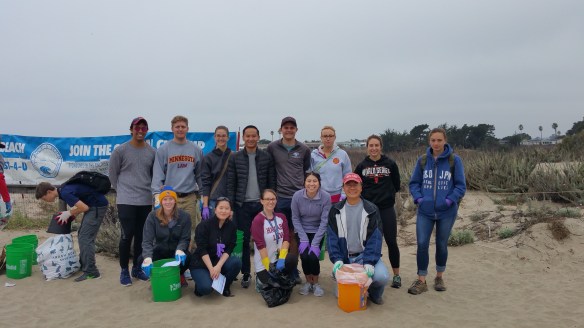
The 2017 Santa Clara Law Environmental Law Society Beach Clean-up Activity was another success!  I joined about 15 students and friends on Saturday morning at Natural

Bridges State Beach for several hours of beachcombing for trash.  We were not the only folks out there; there were groups of boy scouts, individual families, and other community groups.  (From the matching T-shirts, it looked liked the local Sony Company office had a group there as well.)  While the morning was overcast, it was a actually quite a beautiful place.  My small group (Laura, Cynthia, Ayla, and Robin) came up with about 20 pounds of trash, including many small items like cigarette butts and food wrappers to some water and beer bottles.  (The photo of somebody in the brush is of me going after some plastic plates that had been thrown deep into the bushes.  Boooooh, not cool. . . ) Quite amazing how things add up.  Another small group came up with more than 40 pounds of trash.

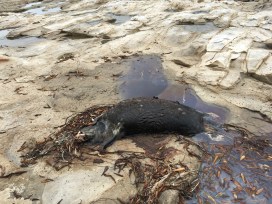
IMG_6419Beyond the typical trash, here were some other items of interest:  an improvised bong (yes, you read that  correctly), lots of shoes, a gasoline can, a propane torch, and an orange traffic cone (not near the road, but deep inside the bushes).  Sadly, we also came across a dead sea-otter.  A rather large animal.  All we could was to report it to the state park official onsite.
All in all, it was a great occasion of community service.  Hooray for the Santa Clara Law Environmental Law Society and all the other folks across the state that pitched in for this year’s coastal clean-up!

Update – 6 Haikus in honor of the SCU Environmental Law Society Beach Clean-up.


Reminder: Regarding Job Openings, Internships, Fellowships, and Other Environmental Law Related Opportunities

I regularly post such items when they come across my email or I become aware of them otherwise.  A lot of what I post is related to non-profit, academic, or the government sector (including international organizations).  These items are usually sorted below the blog entries that I write about substantive issues and thus come further down on the front page.  The easier way to view these opportunities postings is to click on the “Jobs and Other Opportunities” link at the top of the blog page.

Tropical Storm Harvey and Houston Floods

Most of yesterday, I was following the flooding in Houston via online news sites and twitter.  The misery and destruction that Tropical Storm Harvey has brought there has been incredible.  With up to 50 inches of rain expected by the end of this storm, it has created a deluge in parts of Houston that has been described by the National Weather Service as “unprecedented” and having impacts that are “unknown and beyond anything experienced.”

I have a personal interest in the events since my parents live right in the flooded areas in the Southwest part of Houston.  Yesterday, their neighborhood was completely inundated, with all the streets looking like canals.  TV news were showing people getting rescued from homes many feet under water and people walking through chest-high water to get to dry ground.  Fortunately for my parents, the waters stopped rising just after the water had started entering their house.  Hopefully, the flood damage at this point is not too bad.  However, more rain is expected over the next few days.

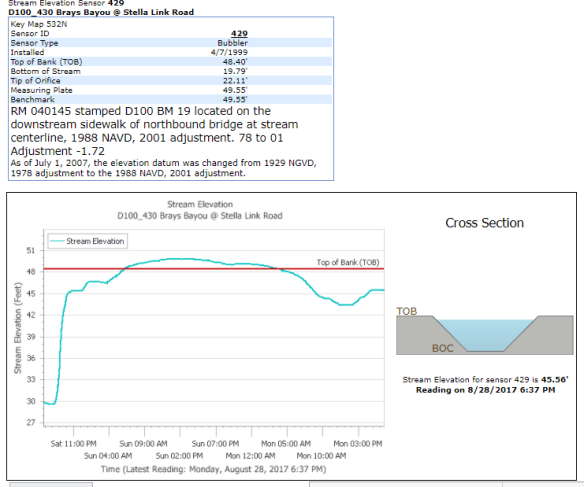
In looking for information about conditions in the area, I came across the stream level gauges that the Harris County Flood Control District operates in the Houston area.  My parents live not too far, maybe just a mile, from the Brays Bayou, which overflowed yesterday. I think this may have been the first time that has happened.  In almost 30 years that they have lived there, they have never seen floods coming into their house.  However, the data from that gauge (Brays Bayou at Stella Link) was fascinating.

Braes Bayou at Stella Link 8-28-2017

When the flooding was worst yesterday (Sunday), the water was about a foot over the banks of the stream, at a stream level of almost 50 ft.  It then started to recede by a few feet, probably because the rains did not come down as heavily in their area. Today, it appears to be rising again.

Braes Bayou at Stella Link pt2 8-28-2017

If one looks at yesterday’s stream level and the historical information, one sees something remarkable.  Yesterday’s top stream level of 49.87” rose to that of a 100-year flood (49.60”).  (The stream bank stands at 48.40”, which means that at its highest level, the stream was overflowing its banks by about a foot.)  When FEMA designates 49.60” as a 100 year flood level, it expects such a deluge to happen, on average, only once every hundred years.

So, Ok – Harvey has been said to be unprecedented in its impact.  And a 100-year flood might not be so unexpected.  (Others have thrown around the comparison to a 500-year flood.)  But past data show that stream elevation was at 48.38” in 2001 (during Hurricane Allison, another really bad event that flooded most of the same parts of Houston) and at 48.30” in 2015, just a couple of year ago.  (Both times, my parents were lucky and were pretty much unaffected.) Both of those levels exceed the 50 year flood levels, 47.50”.

Taken together, this means that over the last 16 year, Houston (and maybe more specifically, the area where my parents live) has had two 50-year flood and one 100-year flood level events!  (And stream levels have reached 10-year flood levels in 5 of the last 10 years — an event that that has been calculated to have a 10% probability has occurred 50% of the time over the last 10 year.)  Hmmm.

Of course, these data points are very specific to one area, and one would need much more data to draw broader conclusions.  (And in any event, this storm and flood is not over, yet.)  But the events are also consistent with the greater variations in weather and higher frequency of severe storm events that scientists have predicted as an effect of climate change.  If this is a sign of what’s to come, as greenhouse gas concentration in the atmosphere rise, we are in a lot of trouble.

I sure hope that I am wrong.  Either way, this is one more example of what is at stake in the effort to bend the curve on greenhouse gas emission.


Lisa Jackson life story on Moth Radio Hour (original broadcast of May 31, 2012)

The Moth Radio Hour recently rebroadcast the show where Lisa Jackson, the first African-American Administrator of the U.S. EPA (2009-2013), told the story of how she became an engineer and then entered the environmental protection field.  I think it’s a great story for young folks, including my law students, to hear about one person’s path into environmental policy and government service, especially that of a racial minority.  Enjoy!

https://themoth.org/storytellers/lisa-jackson


Op-ed on California Electric Vehicle Rebates

Here is an op-ed piece of mine in support of rebates for electric vehicles, appearing in various newspapers.  The Sacramento Bee is running it today:

http://www.sacbee.com/opinion/article169036912.html


Yes: Rebates a prudent way to save world from climate change

By Tseming Yang

California Gov. Jerry Brown may soon sign legislation extending cash rebates given to residents who buy low-emission vehicles from Tesla and other automakers.

While the bill’s details are still evolving, the governor should in principle sign off on the subsidies because they will further spur California’s transition to a clean-energy economy and improve the state’s air quality.

Addressing climate change is the chief motivation for the rebates, which have been in place for years and would be beefed up through the pending legislation. With a populous coastline and dependence on seasonal rains, California is particularly vulnerable to the dangers posed by global warming, including rising sea levels and more-frequent droughts and wildfires. Reducing the state’s greenhouse gas emissions would help not only California but, given the Golden State’s large population, the rest of the world as well.

Among low-emission modes of transit, electric vehicles in particular present a big opportunity to reduce carbon pollution.

And while the use of most EVs does result in some emissions – the electricity used to power them has to come from somewhere, including fossil fuel-burning plants – such vehicles are, all things considered, far friendlier to the environment than traditional cars, a 2015 Union of Concerned Scientists analysis showed. That’s not to mention California’s requirement that utilities in the state to get half their power from renewable sources by 2030, with tougher standards anticipated in the future.

Ultimately, these purchase rebates help create a robust market for EVs and push the transportation sector into better participating in California’s broader transition to clean energy.

Air quality is a key concern.

For decades, vehicle tailpipe emissions have contributed to smog and other toxic air pollution conditions, which are especially harmful to young children, the elderly, and those with asthma and other lung function impairments. Shifting the mix of vehicles on California’s roads toward EVs has become a necessity.

And undoubtedly, the rest of the world stands to benefit from California’s climate leadership.

Decreasing the demand for oil will reduce the need for risky exploration projects and lessen the chances of environmental disasters like the 2010 BP oil spill in the Gulf of Mexico.

Finally, supporting the growth of California’s electric car industry is an investment in the state’s clean-tech sector, which will occupy an increasingly important role in the global economy in years to come.

California’s rebates send an unambiguous signal that, even with the Trump administration’s rejection of the Paris climate agreement, the state is still committed to fostering a thriving clean-tech industry.

Ultimately, California’s low-emission vehicle rebates will support three critical outcomes: lowering carbon emissions harmful to the environment, reducing smog and other forms of air pollution, and boosting economic activity in the state’s clean-energy industry.

That seems like a pretty good deal to me.