| Dear Friends of CGLP,
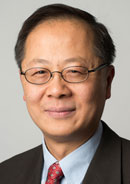 I am excited to take on the role as Director of the Center for Global Law & Policy this academic year. The Center is thriving thanks to the great efforts of outgoing Center Director Professor Donald Polden and the tireless work of our wonderful Senior Program Manager Carly Koebel. Their leadership of CGLP has been crucial to ensuring that the summer study abroad programs and the other parts of the Center have run like clockwork and provided valuable educational and professional growth experiences for hundreds of Santa Clara law students and law students from other institutions over the years. Even though Don is formally stepping down from his role as Center director, he will continue to remain involved in Center activities, especially to help with my transition in the director position, and in the summer programs. I am grateful for his continued efforts and support as well as that of all the other faculty directors leading the various summer programs and Dean Anna Han for her long-standing support for CGLP. I am excited to take on the role as Director of the Center for Global Law & Policy this academic year. The Center is thriving thanks to the great efforts of outgoing Center Director Professor Donald Polden and the tireless work of our wonderful Senior Program Manager Carly Koebel. Their leadership of CGLP has been crucial to ensuring that the summer study abroad programs and the other parts of the Center have run like clockwork and provided valuable educational and professional growth experiences for hundreds of Santa Clara law students and law students from other institutions over the years. Even though Don is formally stepping down from his role as Center director, he will continue to remain involved in Center activities, especially to help with my transition in the director position, and in the summer programs. I am grateful for his continued efforts and support as well as that of all the other faculty directors leading the various summer programs and Dean Anna Han for her long-standing support for CGLP.
Many of you are familiar with my background. But for those who are not, I have been engaged in international teaching, program leadership, and research for much of my academic career. In addition to having directed and taught in CGLP’s Singapore study-abroad program on “Business and the Environment,” I have previously served as a Fulbright Scholar at Tsinghua University Law School in Beijing and as a Visiting Professor at Zhongshan University Law School in Guangzhou. Prior to coming to Santa Clara Law School, I also led a USAID and State Department-funded capacity-building and environmental law training program in China. My research and writing focuses on international and comparative environmental law issues.
Thanks to the amazing work of Don and Carly, the Center has concluded yet another successful set of summer program. Our Center Newsletter here showcases those programs as well as the international activities and accomplishments of our faculty and students and the success of the law school’s international programs. As Don has said previously, something that continues to be true, “Santa Clara Law continues to have one of the most ‘internationally-focused’ law faculties in the United States.”
I look forward to continuing the successful work of CGLP. And if there are new ideas that you think would be worth exploring for CGLP, please feel free to share them with me.
Tseming Yang
Professor of Law
Director, Center for Global Law and Policy
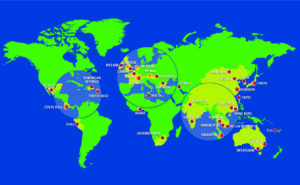 2019 Summer Abroad Programs 2019 Summer Abroad Programs
Costa Rica 2019 – Francisco Rivera
¡Pura Vida! This Costa Rican slang term perfectly describes the three amazing weeks our 16 students had studying international human rights law in Costa Rica this summer. In addition to learning about the human rights norms, bodies, and mechanisms within the United Nations and the Organization of American States, students also explored the natural beauty Costa Rica has to offer. Read more.
Geneva 2019 – Francisco Rivera
Maybe it was getting to see in person so many U.N. agencies and international organizations; maybe it was the variety of international law topics covered in class, or maybe it was the majestic beauty of the lakes and mountains of Switzerland. Most likely, what made the Geneva summer abroad program a success was the combination of all of the above – and the delicious Swiss Mövenpick ice cream! Read more.
The Hague 2019 – David Sloss
We had another successful program in The Hague in 2019. Eighteen students from a total of seven U.S. law schools attended the program. The students were all very enthusiastic about the program. They learned a lot about international law and institutions and had a good time in the process. Read more.
Oxford 2019 – Cathy Sandoval
The 2019 Oxford program had another successful summer. Law students from Santa Clara, Golden Gate, Lewis & Clark, and Syracuse universities gathered at Oxford for the Santa Clara University School of Law Oxford University Summer Program from June through the end of July. Through one-on-one Oxford-style tutorials, students studied and prepared weekly papers on either Jurisprudence, Comparative Property law, International Criminal Law, or Energy and Environmental Law. Read more.
Shanghai 2019 – Anna Han
This past summer, Shanghai welcomed 11 enthusiastic law students who studied Chinese Law for 3 weeks at KoGuan Law School, Shanghai Jiao Tong University, in the heart of this vibrant city. The students learned about doing business in China and the myriad of laws and regulations that apply. After the classes ended, several went on to externships in law firms and courts in cities as diverse as Beijing, Hong Kong, and Taipei. Read more.
Sydney 2019 – Evangeline Abriel
Protection of Australia’s 40,000 year old aboriginal wall art and delicate flora and fauna; exploration of the way the United States, Australia, and the international community respond to refugee and humanitarian crises; tea with an Australian Federal Circuit Court judge — coupled with the Blue Mountains, wombats, and a cruise on a 1900s gentleman’s schooner in Sydney Harbour – what an amazing 2019 Sydney program! Read more.
Tokyo 2019 – Philip Jimenez
During the summer of 2019, twenty law students from across the country, from Maine to California to Hawaii, attended Santa Clara Law’s program in Tokyo. Designed to prepare law students for an international practice, the program includes classes introducing them to the Japanese legal culture, international trade law, protection of intellectual property, and transnational contracts and financing. Once classes have finished, students may choose to serve four or five week externships at law firms in Tokyo, in Seoul, South Korea, or in UlaanBaatar, Mongolia. Read more.
Vienna 2019 – Donald Polden
The Santa Clara summer 2019 program in Vienna provided an excellent opportunity for the students to learn European law and the law of the European Union, while studying in one of Europe’s most beautiful and vibrant cities. More than a dozen students attended the program and then about half of them went to externships placements in Budapest, Kuwait, and Casablanca. Three of the students were from Santa Clara University Law School and the rest came from law schools on the East and West coasts. Read more.
Some photos were winners of this year’s #SCULawAbroad photo contest. Check out our Facebook page to see more photos and videos. (www.facebook.com/SCUCGLP/)
International Human Rights Clinic
In the 2018-19 academic year, students in the International Human Rights Clinic worked on the following projects:
- A report to the U.N. Human Rights Committee highlighting human rights violations that stem from (1) the Trump Administration’s “zero tolerance” policy of forced separation and prolonged detention of immigrant children detained at the southern border, and (2) forced labor and inadequate health services in private for-profit immigration detention centers. The U.N. Human Rights Committee incorporated the clinic’s concerns in the list of issues the Committee will address in an upcoming hearing regarding the U.S.
- A report to the U.N. Committee Against Torture alleging that the U.S. is violating the U.N. Convention Against Torture by separating families and indefinitely detaining immigrant children.
- An amicus curiae brief on reparations owed to a victim of torture in the context of the U.S. extraordinary rendition program, in a case before the Inter-American Commission on Human Rights.
- Public comments to the U.S. federal government opposing proposed immigration regulations relating to the implementation of the Flores Settlement Agreement as violations of international human rights law.
- A resolution adopted by the Board of Supervisors of Santa Clara County declaring the county a “Human Rights County” and designating December 10 as Human Rights Day.
- A joint local government/civil society/academia submission to the U.N. High Commissioner for Human Rights highlighting several actions taken by local city and county governments in and within the county of Santa Clara to promote and protect human rights. These actions were recognized in a report submitted by the U.N. High Commissioner for HR to the U.N. Human Rights Council.
- A joint report between IHRC and the County of Santa Clara on “Women Experiencing Homelessness in Santa Clara County.”
- A report on human rights violations in private immigrant detention centers in the U.S. (focusing on California).
- A legal memo on the applicability of recently enacted criminal justice reform legislation spearheaded by SCU alumna Jessica Jackson JD ’11.
- An amicus curiae brief in support of environmental human rights defenders in a case before the Inter-American Court of Human Rights.
- An amicus curiae brief on the so-called “death penalty phenomenon” in a case before the Inter-American Court of Human Rights.
- Public comments to the U.N. regarding a draft treaty in the area of business and human rights
- Legal memos to assist partners litigating cases involving international war crimes in countries in Africa and Eastern Europe.
Santa Clara Law Student Contributions
Santa Clara Law students have also made important contributions to international law in the specific area of immigration.
- A group of nine Santa Clara Law students, along with Clinical Professors Evangeline Abriel and Lynette Parker and Professor Pratheepan Gulasekaram, provided support to the Florence Immigrant and Refugee Rights Project in Arizona during their spring break, March 2019.
- Through the Katherine and George Alexander Law Center, Santa Clara Law students under the supervision of Clinical Professor Lynette Parker represented survivors of trafficking in persons in applications for immigration relief. Additional representation was provided by students in the Immigration Appellate Practice Clinic, who represented five asylum seekers before the U.S. Court of Appeals for the Ninth Circuit and the San Francisco Immigration Court.
- The La Raza Law Student Association, supported by Deborah Moss-West and the Katharine and George Alexander Law Center, organized and implemented two Bridge to Justice community legal clinics, in which students, under attorney supervision, provided consultations in immigration as well as other areas of law.
- Responding to serious human rights concerns, students in the International Human Rights Clinic, under the supervision of Clinical Professor Francisco Rivera, submitted reports to various United Nations human rights bodies addressing forced separation and prolonged detention of immigrant children, as well as forced labor and inadequate health services in private for-profit immigration detention centers. Students also submitted public comments to the U.S. federal government opposing proposed immigration regulations relating to the implementation of the Flores Settlement Agreement.
- Finally, the student Social Justice Coalition, the Journal of International Law, and the Asian-Pacific American Law Student Association each organized and presented public information events concerning current issues in immigration law.
Santa Clara Law is tremendously proud of our students’ outstanding work and advocacy in these areas!
Event Update
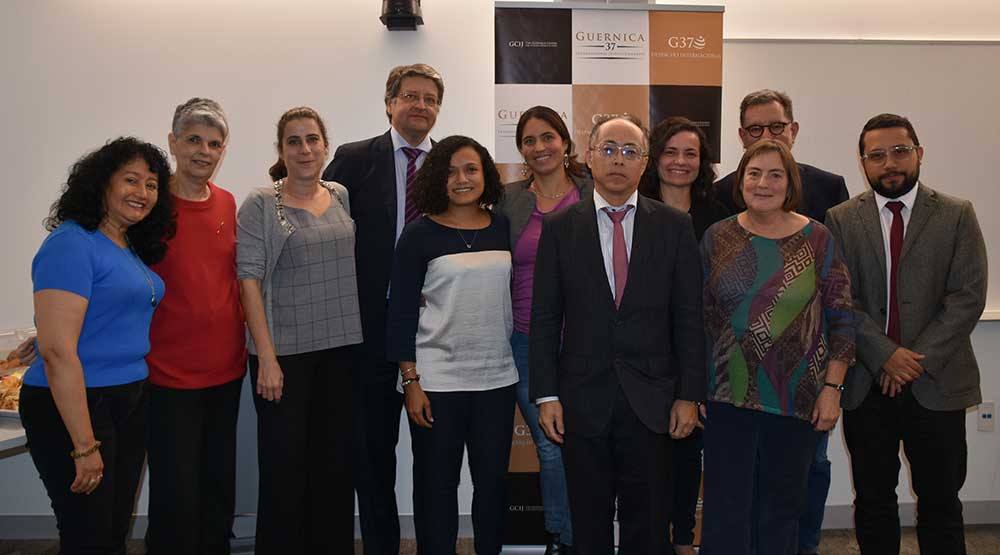
Expert Workshop and Panel Discussion on “Victims and International Justice”
On November 3rd, 2018 Santa Clara University School of Law hosted the first Expert Workshop about “Victims and International Justice”. This expert workshop was organized by The Guernica Group, the Trust Fund for Victims (TFV) of the International Criminal Court, SCU’s Center for Global Law and Policy and the Working Group on Transitional Justice of the Latin American Society of International Law.
The workshop brought together a distinguished group of international lawyers, prosecutors, judges and human rights activists who, for the past 20 years, have played a decisive role in the fight for justice on behalf of victims of international crimes and serious human rights violations to discuss the role and participation of victims in different justice mechanisms.
Participating experts included Yassmin Barrios (Guatemala), Carlos Castresana (Spain), Ligia Bolivar (Venezuela), Henry Rivera (Colombia), Alexandra Sandoval (Nicaragua), Naomi Roht-Arriaza (USA), Beth Van Schaack (USA), as well as a delegation from the Trust Fund for Victims, integrated by Motoo Noguchi, Felipe Michelini and Erin Rosenberg, and members of The Guernica Group, Almudena Bernabeu, Toby Cadman, and Claudia Josi.
Read more.
Faculty Updates
 Evangeline Abriel has been involved in a number of immigration law activities during the past year. In August 2018, she was a member of a team inspecting a juvenile immigration detention center in Brownsville, Texas, under the auspices of the Flores v. Reno class action settlement order, and filed a report of that inspection with class counsel. She also co-authored the manual T Visas: a Critical Immigration Option for Survivors of Human Trafficking, published by the Immigrant Legal Resource Center in 2019. With Lynette Parker and Pratheepan Gulasekaram, she led a spring break service trip to the Florence Immigrant and Refugee Rights Project in Arizona, where Santa Clara law students interviewed immigration detainees seeking asylum and conducted legal and factual research for the Florence Project staff. She co-authored two amicus briefs, with Professor Jennifer Lee Koh, to the U.S. Court of Appeals for the Ninth Circuit, on the issue of whether the term “crime involving moral turpitude” under the U.S. immigration laws is void for vagueness. In December 2018, she spent several days volunteering at Al Otro Lado in Tijuana, Mexico, providing consultations to asylum seekers. She spoke at a number of immigration-related events, including the American Immigration Lawyers Association annual conference. With her students, she currently represents six individuals seeking asylum in the United States, some before the U.S. Court of Appeals for the Ninth Circuit and some before the San Francisco Immigration Court. She was selected as a 2019 Pro Bono Champion by the American Immigration Lawyers Association, Santa Clara Valley chapter. Evangeline Abriel has been involved in a number of immigration law activities during the past year. In August 2018, she was a member of a team inspecting a juvenile immigration detention center in Brownsville, Texas, under the auspices of the Flores v. Reno class action settlement order, and filed a report of that inspection with class counsel. She also co-authored the manual T Visas: a Critical Immigration Option for Survivors of Human Trafficking, published by the Immigrant Legal Resource Center in 2019. With Lynette Parker and Pratheepan Gulasekaram, she led a spring break service trip to the Florence Immigrant and Refugee Rights Project in Arizona, where Santa Clara law students interviewed immigration detainees seeking asylum and conducted legal and factual research for the Florence Project staff. She co-authored two amicus briefs, with Professor Jennifer Lee Koh, to the U.S. Court of Appeals for the Ninth Circuit, on the issue of whether the term “crime involving moral turpitude” under the U.S. immigration laws is void for vagueness. In December 2018, she spent several days volunteering at Al Otro Lado in Tijuana, Mexico, providing consultations to asylum seekers. She spoke at a number of immigration-related events, including the American Immigration Lawyers Association annual conference. With her students, she currently represents six individuals seeking asylum in the United States, some before the U.S. Court of Appeals for the Ninth Circuit and some before the San Francisco Immigration Court. She was selected as a 2019 Pro Bono Champion by the American Immigration Lawyers Association, Santa Clara Valley chapter. |
|
 Michael Asimow presented a paper entitled “Between the Agency and the Court: Ex Ante Review of Regulations” at the Administrative Law Discussion Forum in Lyon, France in June, 2019. Michael Asimow presented a paper entitled “Between the Agency and the Court: Ex Ante Review of Regulations” at the Administrative Law Discussion Forum in Lyon, France in June, 2019. |
|
 |
Colleen Chien is co-editor on a book with fellow SCU professor, Brian Love and has had the following items published in the last year:
- Inter Partes Review and the Design of Post-Grant Patent Reviews, with Christian Helmers, and Alfred Spigarelli 33 Berkeley Tech. L.J. 817 (2019).
- Harmony and Disharmony in International Patent Law, East-West Center Working Paper Series and Book Chapter (2018).
- Comparative Patent Quality, 50 Ariz. St. L.J. 71 (2018).
|
|
|
 Eric Goldman has a forthcoming article: The U.K. Online Harms White Paper and the Internet’s Cable-ized Future, Ohio State Tech. L.J. (2019) (https://ssrn.com/abstract=3438530) In February 2019, he gave opening remarks at COMO at the European Parliament, Brussels, Belgium (topic was content moderation by Internet companies) Eric Goldman has a forthcoming article: The U.K. Online Harms White Paper and the Internet’s Cable-ized Future, Ohio State Tech. L.J. (2019) (https://ssrn.com/abstract=3438530) In February 2019, he gave opening remarks at COMO at the European Parliament, Brussels, Belgium (topic was content moderation by Internet companies)
In December 2019, he is giving a talk at Tel Aviv University entitled “Content Moderation Remedies.”
He was named as a finalist (one of 6 in the world) for the 2018 World Technology Awards, Law Division. |
|
 Brian Love is a co-editor of a new volume published in July by Cambridge Univ Press: Patent Remedies and Complex Products: Toward a Global Consensus. The book is the culmination of a multi-year collaboration among 20 patent law professors drawn from 11 countries around the world. Brian Love is a co-editor of a new volume published in July by Cambridge Univ Press: Patent Remedies and Complex Products: Toward a Global Consensus. The book is the culmination of a multi-year collaboration among 20 patent law professors drawn from 11 countries around the world.
In September, he will be co-teaching the PhD Workshop at EPIP 2019. EPIP (European Policy for Intellectual Property”) is a large academic IP conference held annually in Europe, and this year it will be held at ETH Zurich. The title of the workshop is “The Legal and Economic Analysis of Patent Litigation,” and he is co-teaching it with Christian Helmers from the SCU economics department. |
|
 In May 2019, Prof. Tyler Ochoa gave two lectures on A Comparative (US/EU) Approach to Transnational Intellectual Property Disputes at the University of Verona Summer School in Transnational Commercial and Technology Law. In July 2019, Prof. Ochoa presented a one-unit course on Comparative Rights of Publicity at the University of Augsburg Faculty of Law’s Summer Session. In May 2019, Prof. Tyler Ochoa gave two lectures on A Comparative (US/EU) Approach to Transnational Intellectual Property Disputes at the University of Verona Summer School in Transnational Commercial and Technology Law. In July 2019, Prof. Ochoa presented a one-unit course on Comparative Rights of Publicity at the University of Augsburg Faculty of Law’s Summer Session.
In July 2018, Prof. Ochoa presented a three-unit course on Intellectual Property in the Digital Age at the University of Strathmore, LL.M. Program in Intellectual Property Law, in Nairobi, Kenya. He also published an article on Copyright and Underwater Cultural Heritage in 49 J. Maritime L. & Commerce, 441 (2018). |
|
 Donald J. Polden, Dean Emeritus and Professor of Law, directed the law school’s program in Vienna during the summer of 2019. The students enrolled in the program greatly appreciated the excellent instruction provided by faculty members from the University of Vienna and enjoyed a lengthy visit to the Austrian Supreme Court, complete with a historical tour of the Court’s chambers and work areas. Donald J. Polden, Dean Emeritus and Professor of Law, directed the law school’s program in Vienna during the summer of 2019. The students enrolled in the program greatly appreciated the excellent instruction provided by faculty members from the University of Vienna and enjoyed a lengthy visit to the Austrian Supreme Court, complete with a historical tour of the Court’s chambers and work areas.
Polden served as Director of the law school’s Center for Global Law and Policy from 2016 until August of 2019 when he stepped aside and Professor Tseming Yang began service at the Center’s director. Polden, who was Dean at Santa Clara Law from 2003-2013, greatly enjoyed providing leadership to the Center for our year and looks forward to continuing to serve as a summer program director in future summers. Professor Polden wants to give a well-deserved shout out to Carly Koebel, Senior Program Director in the Center for her outstanding efforts on behalf of the Center.
Professor Polden has continued his scholarly production and assistance to student organizations. In March 2018, he assisted the Santa Clara Law Review in offering a full day conference on “Antitrust in Silicon Valley”. He is producing a law review article for inclusion in the special symposium issue on that subject. Further, he spoke at a national conference on leadership education in law schools held at the University of Tennessee Law School. He is producing a law review article for inclusion in that symposium issue of the law review. Polden also produced a lengthy chapter on “leading the compliance function in corporations” that will be published in a forthcoming book on the compliance function in U.S. companies.
In the fall semester 2019, Polden is teaching classes on antitrust law, sports law and policy and leadership for lawyers. |
|
 Francisco Rivera Juaristi was considered as a potential U.S. candidate to serve on the Inter-American Commission on Human Rights; spoke at the University of Minnesota and Berkeley School of Public Health about the need for a new international treaty to address violence against women; spoke at community events celebrating Human Rights Day in Palo Alto and in Santa Clara County; participated in several panels on campus to discuss issues related to international human rights, immigration, and environmental justice; published a blog post submitted a chapter on “human dignity” for a book commemorating the 70th anniversary of the Universal Declaration on Human Rights; submitted a chapter on “State Responsibility for Corporate Human Rights Violations” for a book on the U.N. draft treaty on Business and Human Rights. Prof. Rivera continues to serve as a member of the National Human Rights Cities Alliance Steering Committee; was appointed to serve in the Human Rights Task Force of the Human Rights Commission of the County of Santa Clara, and serves as a member of the Global Steering Committee for a civil society coalition that is drafting a new UN treaty on violence against women. Francisco Rivera Juaristi was considered as a potential U.S. candidate to serve on the Inter-American Commission on Human Rights; spoke at the University of Minnesota and Berkeley School of Public Health about the need for a new international treaty to address violence against women; spoke at community events celebrating Human Rights Day in Palo Alto and in Santa Clara County; participated in several panels on campus to discuss issues related to international human rights, immigration, and environmental justice; published a blog post submitted a chapter on “human dignity” for a book commemorating the 70th anniversary of the Universal Declaration on Human Rights; submitted a chapter on “State Responsibility for Corporate Human Rights Violations” for a book on the U.N. draft treaty on Business and Human Rights. Prof. Rivera continues to serve as a member of the National Human Rights Cities Alliance Steering Committee; was appointed to serve in the Human Rights Task Force of the Human Rights Commission of the County of Santa Clara, and serves as a member of the Global Steering Committee for a civil society coalition that is drafting a new UN treaty on violence against women.
During the summer, Prof. Rivera co-directed and taught in the law school’s summer abroad programs in Costa Rica and Geneva. |
|
 Catherine Sandoval gave a lecture in July 2019 at Oxford University on the “Native American Reservation Electricity Gap” attended by fellows from the Oxford Energy Institute and the participants in Santa Clara University’s Summer Law program at Oxford University. She also directed the Energy, Environment, and Ethics Conference at Oxford University in July 2019 convened by Santa Clara University School of Law and the National Energy Marketers Association. She organized meetings with the United Kingdom energy regulatory, OfGem, the Energy Attache at the U.S. Embassy, and conference speakers from the academic, private, and non-profit sectors to discuss U.K. energy market design, and energy objectives including addressing climate change and energy efficiency. At the Energy, Environment, and Ethics conference at Oxford University she conducted a lecture on Energy Efficiency, Equity, Market Design, and Climate Change. Catherine Sandoval gave a lecture in July 2019 at Oxford University on the “Native American Reservation Electricity Gap” attended by fellows from the Oxford Energy Institute and the participants in Santa Clara University’s Summer Law program at Oxford University. She also directed the Energy, Environment, and Ethics Conference at Oxford University in July 2019 convened by Santa Clara University School of Law and the National Energy Marketers Association. She organized meetings with the United Kingdom energy regulatory, OfGem, the Energy Attache at the U.S. Embassy, and conference speakers from the academic, private, and non-profit sectors to discuss U.K. energy market design, and energy objectives including addressing climate change and energy efficiency. At the Energy, Environment, and Ethics conference at Oxford University she conducted a lecture on Energy Efficiency, Equity, Market Design, and Climate Change. |
|
 |
David Sloss continues to publish actively in the field of international law. Recent publications include:
- Universal Human Rights and Constitutional Change, 27 William and Mary Bill of Rights Journal 1183 (2019) (with Wayne Sandholtz)
- Book chapter on “United States,” in Duelling for Supremacy: International Law vs. National Fundamental Principles (Cambridge Univ. Press 2019) (Fulvio Maria Palombino, ed.)
|
Professor Sloss has also written several pieces that are due to be published soon, including:
- Domestic Application of Treaties, in The Oxford Guide to Treaties (Oxford Univ. Press, 2nd ed. forthcoming 2019-20) (Duncan Hollis, ed.)
- The Engagement of U.S. Courts with International Law, in Engagement of Domestic Courts with International Law (Oxford Univ. Press, forthcoming 2019-20) (Nollkaemper, Shany, Tzanakopoulos, eds.)
- Section 230 and the Duty to Prevent Mass Atrocities, Case Western Reserve Journal of International Law (forthcoming 2019-20)
- Neither Kantian nor Orwellian (Reviewing Harold Koh, The Trump Administration and International Law), German Yearbook of International Law (forthcoming 2019-20)
Professor Sloss is currently working on a book on Information Warfare and Social Media. He has published a couple of short essays on this topic, which are available here and here.
Finally, Professor Sloss remains active in important international law organizations. He is currently chairing a study group under the auspices of the American Branch of the International Law Association that is examining threats to the liberal international order. The study group will be meeting in New York City in October 2019 and in Santa Clara in February 2020. He is also chairing a Judicial Outreach Committee for the American Society of International Law. The Committee is working with judges from the Second, Fifth, Seventh, and Ninth Circuits to organize panels on international law for their Circuit Conferences next year. |
|
 In February 2019, Tseming Yang published an article entitled “The Emergence of the Environmental Impact Assessment Duty as a Global Legal Norm and General Principle of Law,” 70 Hastings Law Journal 525 (2019). Over the summer, he also completed work on his new casebook, “Comparative and Global Environmental Law and Policy” (with Anastasia Telesetsky, Lin Harmon-Walker, and Robert Percival), which will be released by Wolters Kluwer in September 2019. In February 2019, Tseming Yang published an article entitled “The Emergence of the Environmental Impact Assessment Duty as a Global Legal Norm and General Principle of Law,” 70 Hastings Law Journal 525 (2019). Over the summer, he also completed work on his new casebook, “Comparative and Global Environmental Law and Policy” (with Anastasia Telesetsky, Lin Harmon-Walker, and Robert Percival), which will be released by Wolters Kluwer in September 2019.
In March 2019, he participated in a workshop on “Re-Imagining Environmental and Natural Resources Law,” hosted by the Washington, DC-based Environmental Law Institute at the Johnson Foundation’s Wingspread Retreat in Racine, Wisconsin.
Together with an interdisciplinary group of four faculty colleagues from the Arts & Sciences and the Engineering Schools, Professor Yang co-organized a 2-day conference in May 2019 on “Environmental Justice and the Common Good.” In addition to helping launch environmental justice-focused partnerships with other universities and Jesuit institutions, including a national and global network involving the Society of Jesus and the Association of Jesuit Colleges and Universities (AJCU) Integral Ecology Affinity Group, the conference also helped initiate research collaborations on regional and local environmental justice projects. The conference attracted over 250 students, faculty, staff, visiting academics, and representatives of community-based organizations to Santa Clara University and was broadly supported across the University, including by University President Fr. Michael Engh, the Provost’s Office, and the Ignatian Center, as well as Dean Kloppenberg and the Deans of the other Schools.
In July 2019, Professor Yang gave a presentation on the “Globalization of Environmental Law” at the Stockholm Environment Institute at Chulalongkorn University in Bangkok, Thailand. In August 2019, he gave a presentation on “Cancer Villages in China,” at the IUCN Academy for Environmental Law’s Annual Colloquium, hosted by the Faculty of Law of the Universiti Teknologi Mara in Kuala Lumpur, Malaysia. He was also elected to the IUCN Academy’s Board of Governors for a 3-year term. |
Center for Global Law & Policy
Santa Clara Law
500 El Camino Real
Santa Clara, CA 95053
Phone: (408) 551-1955
CGLP Website
cglp@scu.edu
   
|



 Visiting the EBMUD Wastewater Treatment Plant near Emeryville was a a fascinating experience. (Thank you EBMUD for helping train the next generation of environmental lawyers!)
 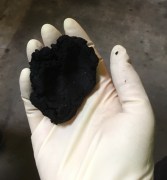 There was a particularly interesting machine that visibly helped settle the solids from the wastewater stream. The end result of the treatment process was a black biosolid that could be handled and had the consistency of clay or dough — in wastewater engineering parlance, a “cake.” The most disturbing aspect of our tour were probably the common usage of food and cooking terminology, invoking images that made some of us queasy: “wet weather primary sludge thickeners” (don’t remember this one at Thanksgiving when making turkey gravy), the biosolids cake, and even a “juicer” used for the high-COD wastes (


 Citizen Yang