
Unknown's avatar

About citizenyang

http://law.scu.edu/faculty/profile/yang-tseming/

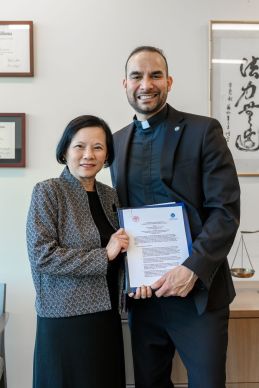
Santa Clara Law and ITESO Announce New Exchange Program

FrArriaga&DeanHanFeb2020mediumStarting next semester, Santa Clara Law students can expect to see an even more globally diverse campus as the Law School and the Instituto Tecnológico y de Estudios Superiores de Occidente (“ITESO”) have signed a new exchange agreement that will open up exciting opportunities for law students and faculty of both institutions.

ITESO is a Jesuit university founded in Guadalajara, Mexico in 1957. Like Santa Clara Law, ITESO is known for its academic excellence, a deep concern for both local and global contexts, and its commitment to social justice. Santa Clara’s Center for Global Law & Policy trains students to meet the challenges of globalization for the practice of law and supports cutting-edge faculty research in international and comparative law to advance justice and the common good.
Santa Clara Law and ITESO Announce New Exchange Program

Santa Clara Law’s International Law Program rated “A+”

Pre-Law Magazine once again gave Santa Clara Law’s International Law program an “A+.”  Regarding our International Law program, the magazine stated, “Santa Clara University School of Law in California, another A+ school in this specialty, is home to the Center for Global Law and Policy, which offers the largest and one of the oldest summer aboard programs in the nation. It offers nine summer class programs as well as more than 30 externship options, including working in large international law firms, local firms, nongovernmental organizations, courts, international organizations and the UN.”

Click to access 069beec41c10e03b9e98aa0b79296d75a1998156.pdf

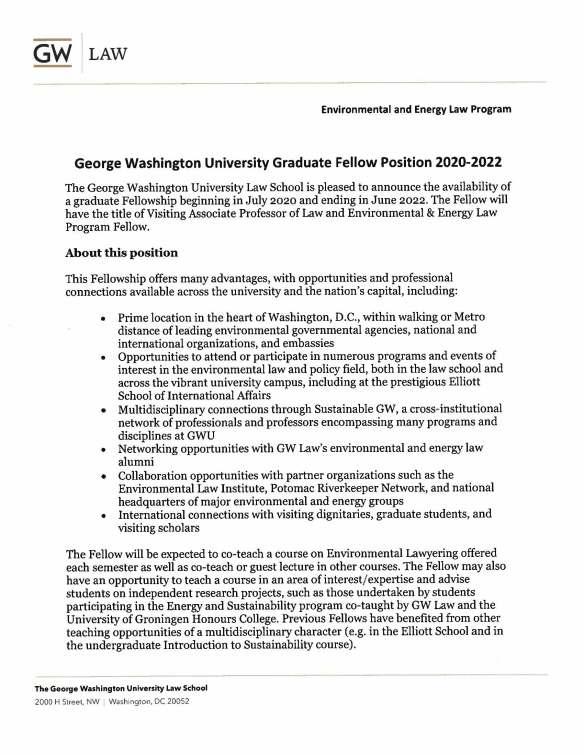
Fellowship: University of Miami School of Law, Environmental Justice Clinic Mysun Fellow (Deadline: January 31, 2020, Miami, FL)

Fellowship starts May 2020.

“This is a one-year fellowship (with the possibility of renewal) based in University of Miami School of Law’s Environmental Justice Clinic. For more information on how to join our team and on our cutting edge work, please go to: https://tinyurl.com/ejcmysunapp The deadline to apply is January 31, 2020.

The University of Miami School of Law’s Environmental Justice Clinic advocates for and seeks to empower low-and moderate-income communities who disproportionately bear the environmental, economic, and health burdens of the development, implementation, and enforcement of the law. Employing a community lawyering approach, we seek systemic change for our clients through advocacy, public policy resources, rights education, and transactional assistance. Our work sits at the intersection of civil rights, environmental, poverty, and public health law, tackling issues in South Florida including climate change, displacement, contamination, environmental health, municipal equity, and more. Increasingly, we view our work through the lens of climate change, one of the most significant social justice issues of our time, and which will be felt most acutely by the poor and marginalized.”


Position: Univ. Colorado Law School, Natural Resource, Energy, and Environmental Clinic, Clinical Professor (Deadline: open until filled, Boulder, CO))

“The University of Colorado is looking for a permanent clinical professor for our Natural Resources, Energy, and Environmental Clinic. The clinic’s mission and vision allow for the clinical professor to cultivate a diverse docket of cases and projects, including matters addressing environmental and climate justice as well as traditional litigation and agency advocacy.”


Unfortunate Comparisons between Ozone and Climate Treaty Systems

Looking for information on the (unhappy) outcomes of the Madrid climate change negotiations, this NY Times Editorial Board piece from a week ago caught my eye.  There is not anything specifically inaccurate in it.  But it just continues to buy into the conventional wisdom that the UN climate change negotiation system is a good process that, like the ozone treaties, will eventually yield success.  Unfortunately, the ozone treaties (the Vienna Convention and the Montreal Protocol) were much simpler treaties.  When they were first created, they involved far fewer countries and were not nearly as ambitious.  There is one other issue that I wish people talked more about.  Climate change is, as a practical matter from the carbon emission perspective, not really a “global” problem, even though the global negotiation process pretends it to be.

Twenty countries account for more than 80% of the world’s carbon emissions; the top 10 countries account for 71%; and the top 5 for 61%.  (Take a look at the Union of Concerned Scientists carbon emission chart as well as the statistics of the International Energy Agency.) Imagine having a negotiation among these 5 countries, China (29% of world emission), US (16%), India, Russia, and Japan (instead of the 200 within the UNFCCC),  where the outcome would address almost 2/3 of the world’s carbon emission.  Heck, if you threw in the European Union (EU-28), you would have a whoppy 6 party negotiation and capture an additional 10% of carbon emission for a total of 71% of world emission.  Of course, negotiating among these countries would be no cake-walk.  But at least, the negotiators would no longer be able to hide in the crowds and behind the facade of semi-anual gigantic international conference with an enormous carbon footprint.