
Unknown's avatar

About citizenyang

http://law.scu.edu/faculty/profile/yang-tseming/

Happy Year of the Pig

Today is the first day of the year of the pig. Happy new year to all of my friends, colleagues, and acquaintances from snowy Vermont. Unfortunately, there really is not much of a festive atmosphere here in Vermont since there is not much of an Asian community here. Nevertheless, after making the obligatory family phone calls, I am vicariously experiencing the festivities by watching new years programming on the CCTV 4 channel on cable.

The Chinese Small Animals Protection Association is asking the National People’s Congress to draft a law protecting animal welfare. (SCMP 2/17) The focus seems have been an instance of cruel treatment of several hundred cats in Tianjin. It is interesting to see something like this in the wake of last years anti-rabies campaign. In a couple of cities thousands of dogs, some of them family pets, were clubbed to death as a preventative measure to curb the spread of rabies. (See, e.g., Xinhua 8/5/2006) Would a law banning animal cruelty have made a difference in such a campaign? Considering how poorly many laws are enforced, it does not seem likely.

By the way, I am not sure how widely folks have caught on to the following interesting tid-bit – last month, Mr. Xie Zhenhua was appointed deputy chief of the NDRC (National Development and Reform Commission). (Xinhua 1/19/2007) In case the name does not ring any bells, Xie Zhenhua was the former chief of SEPA until he resigned in December 2006 in an effort to “take responsibility” for the Songhua river benzene spill. The benzene spill fouled the water supply of the city of Harbin in Heilongjiang province and resulted in a several day shut-off of the municipal water supply in the middle of winter.

While, I think, it’s always been clear that Xie Zhenhua was not the official primarily responsible for the spill or the mismanagement of the spill response, including keeping the contamination secret from the public, his forced resignation had been intended to send a signal that highly placed officials had to take responsibility and be accountable for government failures that had serious consequences. Xie’s appointment is to one of the most powerful central government commissions. The elevation, only a little more than a year after his supposedly being held responsible for the Songhua river spill, is really a mockery of the idea of accountability. In all fairness to him, I suppose that he is really being rewarded for being the scapegoat and willing fall-guy for what happened with the mismanaged spill response. But it also means that the message of deterrence of holding high-ranking government officials “accountable,” for example by forcing them to resign, has little substance and rings rather hollow.
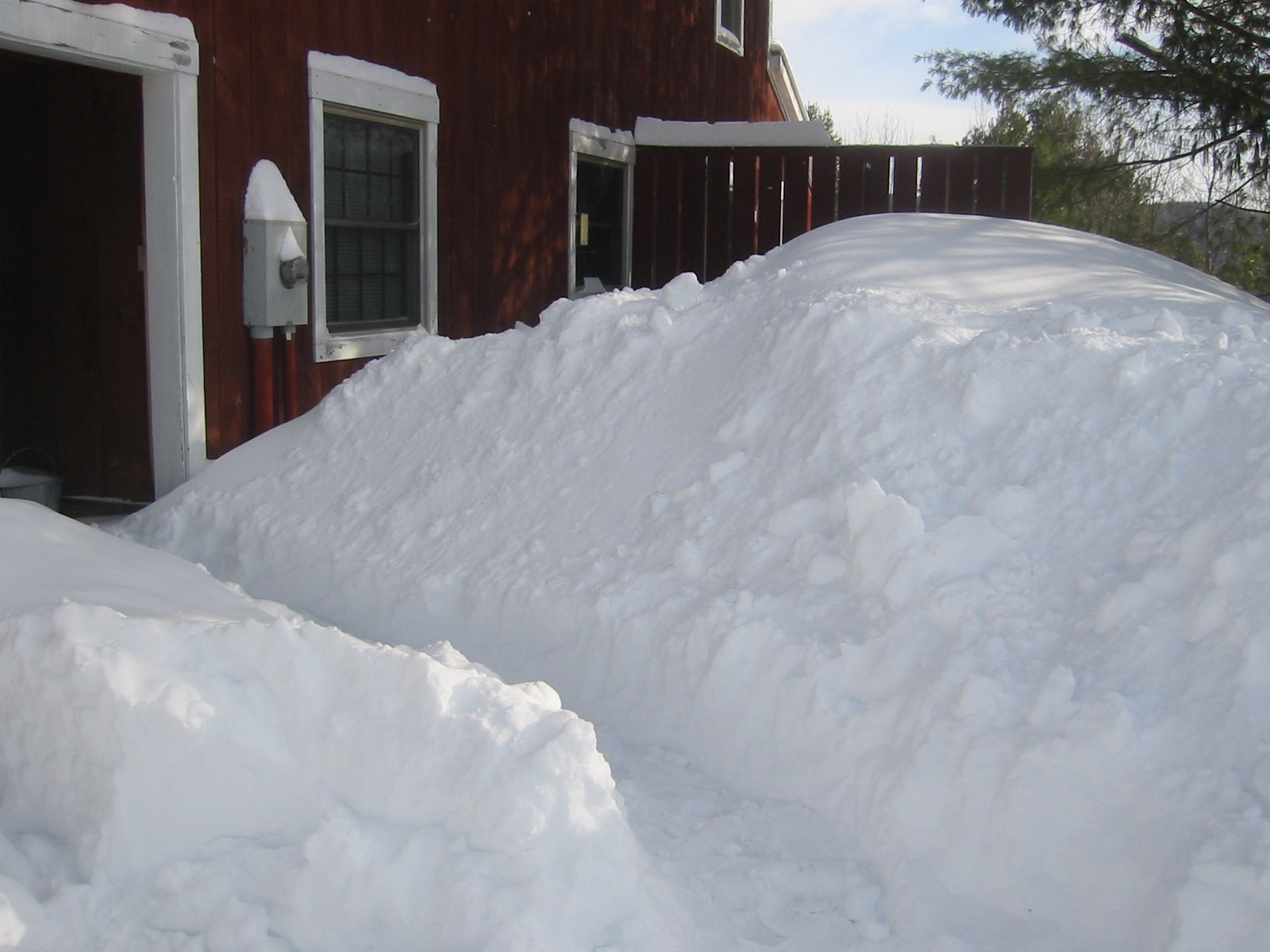
SNOW!

Citizen Yang has been inundated with snow. On Wednesday, after having received only a few inches of snow at a time all winter, we received about 3 feet (about 1 meter of snow) in one day. My snow-plow guy had to come twice and I spent several hours shoveling snow.

More evidence of climate change? Who knows . . .

China and the IPCC report

With the recent release of the IPCC report, there have been some responses by Chinese officials to the report. There is clear acknowledgment of the science of climate change and the seriousness of the problem, unlike past positions of the Bush Administration. Unfortunately, the response by some Chinese officials was not as positive with respect to China’s mitigation efforts. Qin Dahe, chief of the China Meteorological Adminstration, suggested that the cost of reducing carbon emissions might be too high for China to bear at this time because it relies on coal for 70% of its energy needs and because conversion to clean energy sources would be expensive. (SCMP 2/7/07) Of course, China still has much lower per capita carbon emissions than industrialized countries. But given that climate change is expected to continue to change precipitation patterns, including exacerbating water availability that already seriously impacts parts of China, taking the challenge of climate change consequences more seriously should arguably be of much higher priority to China’s government. After all, fixing environmental problems before they arise is inevitably cheaper than fixing them after the fact.

By the way, I have not been posting here for various reasons. (A couple of weeks ago, my wife Tinling Choong’s novel was released into bookstores nation-wide – her website is at http://www.tinlingchoong.com — and I was in China for parts of December.) But over the next few weeks, I am going to catch up on some things, including some observations from my trip to the Guangdong countryside and to one of the “cancer” villages there. Over the coming weeks, I am also planning to change the format of my blog, posting on environmental topics beyond China.

Program Administrator Position for VLS-SYU Partnership

PROGRAM ADMINISTRATOR
Vermont Law School – Sun Yat-sen University Partnership for Environmental Law in China

With the support of a 3-year grant from the United States Agency for International Development (USAID), Vermont Law School has embarked on a collaborative project with the Faculty of Law at Sun Yat-sen University in Guangzhou, China to offer training in environmental law and policy, with a particular emphasis on energy law. Working with legal educators, attorneys, lawmakers, utility analysts, regulators and citizen groups, this collaborative project seeks to enhance understanding of and public participation within our respective legal systems and institutions to advance more effective application and enforcement of environmental laws and policy. An overarching objective of this collaborative project is to enhance the capacity of members of local Chinese communities to become more effective environmental and energy problem solvers and to help develop enduring institutions that will continue to address problems of deep mutual concern, including the reduction of greenhouse gas emissions that contribute to global warming.

Working under the supervision of the VLS-SYU Program Director, the Program Administrator will provide support for all facets of the collaborative project which will include arrangements for conferences, workshops, lectures, and communications in both China and in the US. The support will include handling arrangements for travel (for both Chinese visitors to the US and US personnel traveling to China), visas, translators, accommodations for all faculty members, students and professional staff participating in program activities, and any other related duties as assigned by the Program Director. The Program Administrator will also serve as a principal resource for visiting Chinese students, academics and professional staff who may be in residence at Vermont Law School to participate in program activities. This support includes, but is not limited to, language assistance (particularly in written communications or projects) for any program participants visiting from China. The Program Administrator will assist in the production of program-related materials, articles, books and any other communications that advance the purposes of the collaborative project. The Program Administrator will also work closely with the financial management team at VLS and the Program Director to maintain proper accounting of all program-related expenses and reporting requirements as dictated under the terms of the USAID grant.

The successful applicant must be fluent in Chinese (Mandarin) (both in speaking and in writing) and be available to travel to China for periods ranging from one to two weeks at a time. A bachelor’s degree (or higher degree) is required and must be coupled with study or work experience in international studies, environmental law and policy, energy policy, and/or Chinese history or culture. Candidates with formal legal training and experience in any related fields will be preferred. The Program Administrator will be based at Vermont Law School. Funding for this position is supported by the USAID grant and will provide salary and benefits for the three year term of the grant. Optimally, the successful candidate will be able to commit to working with the program for the entire three year term of the grant.

APPLICATION PROCESS: Please send a letter of application, a current resume or C.V. and list of references (at least 3) to: N. Bruce Duthu, Professor of Law & VLS/SYU Program Director, Vermont Law School, South Royalton, VT 05068. Applications will be reviewed starting immediately until the position is filled. Applicants may submit materials electronically or in hard-copy form.

Vermont Law School, a private, independent institution, is Vermont’s only law school. It offers a traditional Juris Doctor (J.D.) curriculum that emphasizes the public-serving role of lawyers, a Master of Studies in Environmental Law (M.S.E.L.) degree for lawyers and non-lawyers alike, and two post-J.D. degrees, the LL.M. in Environmental Law and the LL.M. in American Legal Studies (for international students). The school’s Environmental Law Program is recognized as among the best in the nation. The Environmental Law Center, a recipient of the American Bar Association Award for Distinguished Achievement in Environmental Law and Policy, is the largest graduate environmental law program in the country, providing both classroom-based and “real-world” opportunities for students to engage actively in environmental and natural resource issues. For more information please call (802) 831-1309, or visit Vermont Law School on the Web at http://www.vermontlaw.edu.
Vermont Law School is an Equal Employment Opportunity Employer.

Essay on the Chicago Climate Exchange and the New England RGGI

I have posted an essay on carbon trading and the problem of enforcing program-wide emission caps on my website. (http://www.vermontlaw.edu/faculty/tyang) It is entitled “The Problem of Maintaining Emissions “Caps” in Carbon Trading Programs Without Federal Government Involvement: A Brief Examination of the Chicago Climate Exchange and the Northeast Regional Greenhouse Gas Initiative.” My bad for the long title, but I like to have the title be reflective of the content. The essay is based on a presentation I did for a climate change symposium at Fordham law school last spring and looks specifically at the Chicago Climate Exchange and the New England Regional Greenhouse Gas Initiative. Any comments are welcome.

There was a related article in the New York Times Magazine a couple of months ago, “Capital Pollution Solution?,” by Jeff Goodell (July 30, 2006). Unfortunately, I can’t link to the story since the NY Times website requires payment for access. Overall it was a very good article on the Chicago Climate Exchange (CCX). The CCX is essentially a voluntary carbon trading arrangement, which includes large companies like International Paper and BP. However, the article was inaccurate in asserting that the commitments of CCX members are unenforceable. In fact, like other private contractual schemes, failure by a member to comply with their emissions limits could be enforced through the CCX’s provision. Of course, whether that has ever happened is quite another matter.

Pollution and the 2008 Beijing Olympics

It’s official, now. How will Beijing to achieve environmental quality standards, especially air quality, for the 2008 Olympic Games? At this point, air quality standards are not being met. Based on plans released to Beijing newspapers, major industrial polluters will simply be ordered to stop operating for the duration of the games. Construction activities will also be halted. (SCMP 9/16).

A Peking University professor has denounced one part of those plans, which calls for the rounding up and expulsion of about 4 million migrant workers (also called peasant workers) from the city before the games.

More on that Xinqiang river spill

The two companies (Haoyuan Chemical Company and Taolin Lead-Zinc Ore Chemical Plant) that are thought to be responsible for the arsenide pollution of the Xinqiang river have been reportedly detained. (Xinhua 9/11) According to the Xinhua report,

“The two companies had not passed any environmental assessments and had no pollution treatment facilities. They have been discharging waste water with arsenide content more than 1,000 times higher than the national standard directly into Xinqiang River for a long time, said the official.

Haoyuan Chemical Company discharged nearly 50,000 tons of wastewater every month, and Taolin Lead-Zinc Ore Chemical Plant 280 tons, [a SEPA official] said, without revealing over what time period.”