Unknown's avatar

About citizenyang

http://law.scu.edu/faculty/profile/yang-tseming/

Comparative Environmental Law: A Global Perspective

Front cover of Yang Handbook of Comparative Environmental Law

Several weeks ago, our new book (co-edited with Anastasia Telesetsky and Sarah K. Phillips), Handbook of Comparative Environmental Law was published by Edward Elgard Publishing. [Here is also a direct link to Publisher’s book webpage.] The volume surveys the field of comparative environmental law, highlighting key developments across legal systems, common threads, emerging directions, and areas of continuing uncertainty. Most importantly, it brings a global perspective to the field, covering not only the well-studied nations of the global North but also jurisdictions that have historically received much less attention.

Why this book? The urgency of transnational and global environmental challenges is evident in the daily news – ranging from climate change to biodiversity loss to plastics pollution.  To date, much of the international community’s attention in the search for solutions has focused on the negotiation and adoption of environmental treaties, such as the 2015 Paris Agreement on climate change. Yet treaty-based approaches have oftentimes disappointed and underperformed. In the meantime, environmental law at the national level has proliferated and grown ever more sophisticated, complex, and diverse.  Today, robust environmental law is found not only in developed nations but also in emerging economies and the developing world. 

Gaining a better understanding of national environmental law systems, especially how they converge or diverge, is then crucial for several reasons. First, when environmental treaties fail to provide timely solutions, national laws provide important alternative or supplementary pathways to solutions. While not all national environmental regulatory systems are equally effective, law reform efforts can benefit greatly from comparative insights into what approaches work best.

Second, the spread of environmental law across the globe itself has created a pressing need for businesses engaged in transnational deals to possess sophisticated knowledge of foreign regulatory systems; otherwise, they risk liability, delays, or other costs. Finally, as cross-border disputes involving environmental issues become more common, courts and arbitral tribunals themselves must develop a stronger command of comparative environmental law to ensure outcomes that are fair, just, and consistent with applicable legal principles. For lawyers engaged in such transnational disputes, expertise in comparative environmental law will undoubtedly benefit their clients.

What is in the book? Our book is designed to contribute to the broader understanding of comparative environmental law.  With contributions from scholars around the world, it is organized into five parts. Part I offers an overview of the book as well as a primer on comparative environmental law (including an introduction to comparative law study generally). Part II explores planning and sustainability approaches to environmental regulation, including environmental impact assessment, PRTR (Pollution Release and Transfer Registries), and sustainability perspectives.  Part III focuses on rights-based frameworks, including the right to a healthy environment, access to information, indigenous peoples’ rights, and rights of nature. Part IV examines accountability mechanisms, including criminal and non-criminal enforcement, environmental courts, and public interest litigation. Finally, Part V surveys or examines issues arising in a number of sectors, ranging from contaminated lands and energy to water pollution and water rights, mining, food waste, biodiversity and air pollution.

In future blogposts, I will highlight some of the most thought-provoking trends that our contributors have identified.  In the meantime, I welcome your thoughts or comments.

“What I did last summer (2025)”

Yesterday, my colleagues and I at Santa Clara Law did something a little different . . . In a throwback to our time as kids, we all did “What I did last summer” write-ups.  Professor Eric Goldman and his research assistant turned these short write-ups into posters that we then presented in a fair in the law school building.  What a fun way to share with colleagues and students our summer activities (and to learn what they were up to)!  (And Kudos to Eric for organizing it! Thank you!)

Position: Chesapeake Legal Alliance, Attorney (Deadline: Rolling, Annapolis, MD)

Chesapeake Legal Alliance has a environmental attorney opening (3-7 years of litigation experience, ideally licensed in Pennsylvania) to co-lead litigation and case management. This seems to be ideal for a person early on in their legal career. The organization does great work for the Chesapeake Bay. For additional info and a link to apply, see this link.

Climate Change Law Writing Competition (Deadline: April 21, 2023)

Here is a writing competition that could be perfect for a law student interested in writing a climate change law paper for spring semester course.

The Center for Climate Integrity and Law Students for Climate Accountability are sponsoring a law student writing competition entitled “Emerging Theories of Climate Accountability.” The paper should be on a “new or emerging legal theory related to climate change and corporate accountability.” Length is 2500 – 4500 words, with a prize of $2,500 and publication in a law journal to be announced. See the actual announcement here and in image below.

Monterey Bay Aquarium Sea Otters!

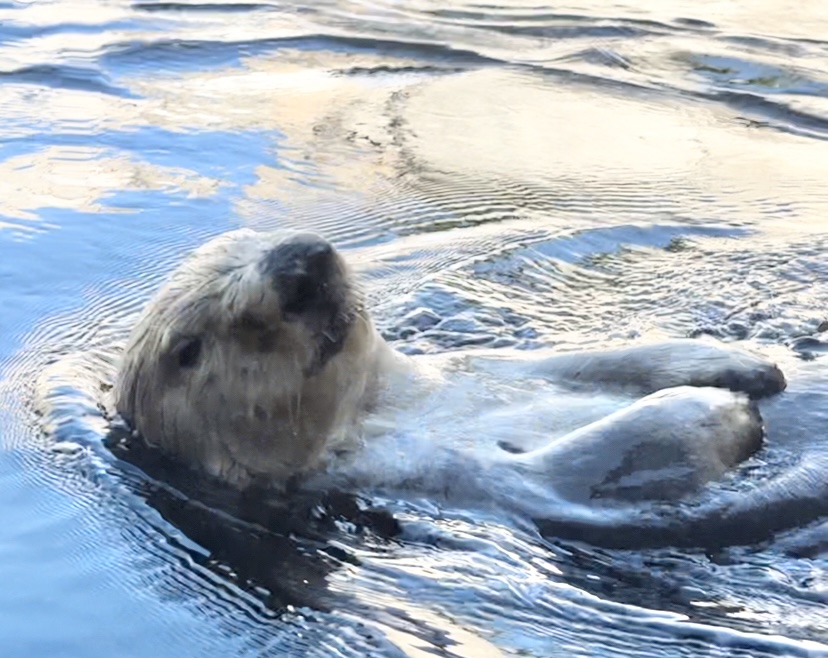
My environmental law students and I spent half of Friday at the Monterey Bay Aquarium to learn about the marine environment and to see the Southern Sea Otter! What a blast! We saw the otters in the Bay as well as in the Aquarium habitats. And as a bonus, some unusual drama – a sea turtle attacking and munching on a small tuna in the “Open Sea” tank exhibit. (It’s the Aquarium’s largest tank exhibit, I think, with a 90 ft window.) I had never seen that before. I remember an Aquarium docent mentioning on a past occasion that the predators in the tank (for example sharks) do not go after the other fish because they are well-fed by the Aquarium staff. I guess somebody forgot to tell the sea turtle. (For a video of the sea turtle and the tuna, see my instagram @proftseming)

Apart from wandering the Aquarium exhibits, our class visit revolved around a formal discussion of the Southern Sea Otter, a species that is listed as threatened under the Endangered Species Act. The Sea Otters were hunted to the brink of extinction in the 18th and 19th century due to the fur trade. By the time the US entered into the 1911 North Pacific Fur Seal Treaty, which also provided some protections to sea otters, the population had been decimated. However, the Southern Sea Otter has made a remarkable come-back, though it is still listed as “Threatened” under the Endangered Species Act in 1977. More importantly, recovery of the otter population in the Monterey Bay has also brought great benefits to the marine ecosystem. (The otter is a keystone species that helps to control the sea urchin population, which can do severe damage the kelp forest if left unchecked by otters.) However, in response to a petition by the Pacific Legal Foundation to de-list the Southern Sea Otter, the US Fish and Wildlife Service is now actively considering removing it from the protections of the ESA. ☹️ Boooooh. (For example, the ESA prohibits harassment of otters and allows for imposition of criminal penalties for violations.)

While the prospect of the Monterey Bay Sea Otters losing ESA protection might be dismaying, otters would still be covered by the protections of the Marine Mammal Protection Act of 1972. So, these amazing and beautiful animals should continue to thrive and be part of Monterey Bay and the California sea coast marine environment in the future.

By the way, shout-out to the Monterey Bay Aquarium which was so generous and kind to allow our class field trip as part of their Education Program’s “College Field Trips.” Thank you! What a great educational resource the Aquarium is! @montereybayaquarium

Environmental Justice Faculty Positions: Several at Santa Clara University, San Francisco State Univ. & California State Univ. Sacramento (various deadlines)

Three interesting faculty positions in the environmental justice field, including a previously posted opening in the Environmental Studies Dept. at Santa Clara University.

1. Santa Clara University, Environmental Studies Department – opening for Assistant Professor of Race, Justice and the Environment (deadline: October 30, 2023).

2. San Francisco State University, School of Environment – opening for Assistant Professor of Environmental Issues & Environmental Justice in Black and Latinx/e Communities (application review begins January 17, 2024). More information here.

3. California State University Sacramento, Dept. of Environmental Studies – opening for Assistant Professor in Environmental Health Equity (application review begins November 27, 2023). More information here.

Post-grad Fellowships in Environmental Law/Policy: Several at UCLA Law School, UC Berkeley Law School, & Univ. of Mississippi Law School (various deadlines)

Here are three post-grad fellowship announcements from my email inbox. Links to more detailed position descriptions and applications are included. (UCLA Emmett Institute is also looking for an Energy Project Director, with 7+ years experience, which I didn’t include here.)

UCLA Law School (application at end of description, deadline December 5, 2023):Emmett Institute Fellowship in Environmental Law and Policyhttps://recruit.apo.ucla.edu/JPF08901

UCLA School of Law’s Emmett Institute on Climate Change and the Environment is now accepting applications for the UCLA Emmett/Frankel Fellowship in Environmental Law and Policy for the academic years 2024-2026. This fellowship is a full-time, two-year academic position beginning in the summer of 2024. The position involves research and writing in the law and policy of climate change and the environment; teaching; and assisting with Institute projects such as conferences and workshops.

See job description here for more detail and instructions to apply.”  

UC Berkeley Law School (application link at end of description, deadline Nov. 5, 2023): “We seek to hire two new Research Fellows to conduct research and engagement on water and environmental issues with a growing and dynamic team. 

Our work at CLEE combines scholarly rigor with careful attention to real-world impact. Our team consistently develops innovative ideas, generates analysis oriented around actionable impacts, and uses this work to support concrete policy actions, all co-produced with stakeholders and decision-makers. If you are interested in work that spans the continuum from knowledge to action on environmental issues, join us! 

Please share with interested networks, send your best contacts my way, and of course I’m happy to answer any questions if you’d like to reach out directly. Links to detailed position descriptions are here: https://aprecruit.berkeley.edu/JPF0415 and https://aprecruit.berkeley.edu/JPF04159.”

University of Mississippi Law School (application link at end of description, deadline not specified): “The National Sea Grant Law Center is hiring! We are currently seeking applications for our Ocean and Coastal Law Fellowship Program. During the one-year fellowship, which may be extended for a maximum of two years, the Fellow will conduct legal research, write articles, and prepare white papers and other materials under the supervision and direction of the Law Center director. The Fellow will also assist with the development of workshop/conference sessions, webinars, and other events hosted by the Law Center, and have the opportunity to travel to select workshops/conferences to present research findings. Candidates with experience and interest in ocean, coastal, and marine resources are preferred.

A J.D. from a law school accredited by the American Bar Association is required by starting date. Applicants should have strong law school academic records; relevant course and/or work experience and interest in one or more of the following – ocean/coastal, natural resources, environmental law; and demonstrated ability to conduct legal research and writing.

The University of Mississippi is an EOE/AA/Minorities/Females/Vet/Disability/Sexual Orientation/Gender Identity/Title VI/Title VII/Title IX/504/ADA/ADEA employer.

Applications must be submitted through the UM Careers portal. Applicants may access the official posting and apply through this link.”

Summer Law Clerkship (paid): 2024 Summer Clerkship, Legal Office, California Air Resources Board (Deadline: November 3, 2023, Sacramento, CA)

A great summer law clerkship with California’s Air Resources Board for 2024 summer, one of the leading environmental regulators in the country (and even more progressive and forward-looking than even the federal government on issues such as climate change). Note that the deadline is November 3, 2023. See the link below for details on the position and application process.

https://www.calcareers.ca.gov/CalHrPublic/Jobs/JobPosting.aspx?JobControlId=396500

Summer Fellowship/Grant: Summer 2024 Env. Law Diversity and Inclusion Fellowship Program, Environmental Law Section of California Lawyers Association (Deadline: Oct. 30, 2023)

Great Opportunity. Fellowship not only comes with a $8000 summer stipend, but also placement in a government agency or public interest environmental organization. Deadline is October 30. For additional info, see the fellowship website.