By Cynthia Yuan and Shannon Cullen
Background
Not all fossil fuels are equal in the equation for carbon emissions. Natural gas continues to be a source of energy that is deemed “cleaner” than coal, with lower carbon emissions. One type of natural gas extraction is hydraulic fracturing (“fracking”), which has become more prevalent with modern-day technology. Fracking describes the process in which companies extract natural gas embedded in shale, a type of fine-grained sedimentary rock. Drillers inject a mixture of water, sand, and chemicals into the shale formation to create fissures for the gas to come up. Fracking has become so lucrative that companies are going to extreme lengths to protect their interests. Imaginative strategies companies implement now includes filing for copyright protections for fracking documents. However, companies may not be very successful.
Controversy
Fracking has been a controversy among environmental groups and the general public due to a variety of reasons, such as chemicals leeching into the groundwater or earthquakes occurring when active faults are drilled. However, the main controversy is whether disclosures of certain documents lowers the bar for other companies to enter the fracking industry.
In the case of Kern River Gas Transmission Co. v. Coastal Corp., Kern River sought Commission approval to construct a pipeline from Southwestern Wyoming, through Utah and Nevada, to Southern California. Kern River Gas Transmission Co. v. Coastal Corp., 899 F.2d 1458, 1460 (5th Cir. 1990). During this process, Kern River disclosed topological maps it had prepared at its expense. A competitor then got ahold of these maps. In an unusual move, Kern River registered the maps with the Copyright office and sued for protections under copyright law. The Fifth Circuit held that the maps were not protectable under the Copyright Act. As a result, competitors freely obtained information pertaining to the locations of natural gas as well as the proposed pipeline route.
This ruling has the potential for lowering the bar for companies to enter the industry, since companies would not need to bear the expense of creating its own maps. Critics fear that with the entry lowered, more companies may enter the industry, and as a result, more fracking may occur. More competition will also lower natural gas prices, increasing overall natural gas dependency.
Analysis/Evaluation
Although there is an argument that not protecting fracking maps will result in more companies entering the industry and result in more fracking, the opposite may in fact be true. Allowing the information to be made public may alert the public about shale gas under their properties. Property owners will then be warned and could take measures such as hold out against sales by gas companies or move. Gas companies could then encounter more difficulty and greater cost from homeowner actions. More importantly, the Copyright Act was not intended to serve as an environmental regulatory tool, and in applying the relevant law, courts should decide whether something is copyrightable without speculating about potential market impacts. Companies should also recognize that copyright law is not an avenue for protecting information.
Conclusion
With the technology today, fracking has become so lucrative that companies are resorting to unusual strategies to preserve their wealth. It is important to recognize that controversial cases do not always result in poor environmental decisions. However, in the absence of more sustainable energy options, companies will continue to anger critics on both sides of the environmental debate.
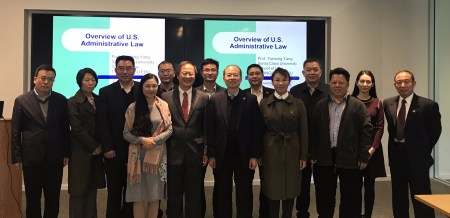 I had a very interesting Monday morning earlier this week, which happened to be in a law firm conference room in Palo Alto. I gave a presentation introducing the basics of American administrative law to a delegation of senior officials of the Legislative Affairs Office (LAO) of China’s State Council (as well as some officials from provincial legislative affairs offices). The group of 14 officials are in the US on a study tour, spending this week in the SF Bay area and next week in Washington DC. In DC, they’ll visit the US Department of Justice and the Interior Department.
 Here’s a picture of me with the head of the delegation, Director General Li Mingzheng of the Government Legal Affairs Research Center in the LAO. The gift in the picture is a stylish silk neck tie. Undoubtedly, it will seriously enhance my wardrobe. But even with out that gracious gift, the discussion with the delegation members itself was well worth my time that morning.
 Citizen Yang